Posted on Leave a comment

Quels Critères Vérifier Avant De S’inscrire À Un Casino En Ligne ?

Quels Critères Vérifier Avant De S’inscrire À Un Casino En Ligne ?

Lorsqu’un joueur découvre un nouveau casino en ligne, il peut être tenté de créer rapidement un compte pour profiter des jeux ou d’une offre promotionnelle. Pourtant, une inscription ne devrait pas se faire uniquement en fonction d’un bonus ou de l’apparence du site. Pour comparer les meilleurs nouveaux casinos en ligne, plusieurs éléments doivent être examinés avant de fournir ses informations personnelles et d’effectuer un premier dépôt.

Alors, Quels Critères Vérifier Avant De S’inscrire À Un Casino En Ligne ? La licence, la sécurité, les moyens de paiement, les jeux disponibles, les conditions des bonus, le service client et les outils de jeu responsable font partie des points importants. Un casino nouveau en ligne peut présenter une interface moderne et une offre intéressante, mais cela ne suffit pas à déterminer si la plateforme correspond réellement aux attentes du joueur.

Vérifier la licence et la réglementation

La première vérification concerne le cadre réglementaire du casino.

Un opérateur légal doit généralement disposer d’une autorisation ou d’une licence délivrée par l’autorité compétente dans le marché où il propose ses services.

La licence permet notamment d’identifier l’opérateur responsable de la plateforme et de vérifier le cadre dans lequel il exerce ses activités.

Avant de s’inscrire, il est donc recommandé de rechercher les informations réglementaires directement sur le site du casino.

Il faut vérifier le nom de l’opérateur, le numéro de licence lorsqu’il est indiqué et l’autorité qui a délivré cette licence.

Une licence ne garantit pas qu’un joueur gagnera de l’argent, mais elle constitue un élément important pour évaluer le cadre légal et les obligations de l’opérateur.

Examiner la sécurité du site

La sécurité des données constitue également un critère essentiel.

Lors de l’inscription, le joueur peut être amené à fournir différentes informations personnelles. Il est donc important de vérifier que la plateforme utilise des mesures de sécurité appropriées.

Le site doit notamment utiliser une connexion sécurisée lorsque les utilisateurs saisissent leurs informations.

Le navigateur affiche généralement un symbole de cadenas à côté de l’adresse du site lorsqu’une connexion HTTPS est active.

Il faut également éviter de transmettre ses identifiants à d’autres personnes et utiliser un mot de passe suffisamment robuste.

Les conditions de confidentialité du casino peuvent aussi être consultées afin de comprendre comment les données personnelles sont traitées.

Regarder les méthodes de paiement disponibles

Les options de paiement peuvent varier considérablement d’un casino à l’autre.

Avant de créer un compte, il est utile de vérifier si les méthodes proposées correspondent à vos besoins.

Selon le marché concerné, une plateforme peut proposer :

  • cartes bancaires ;
  • portefeuilles électroniques ;
  • solutions bancaires en ligne ;
  • virements bancaires ;
  • autres méthodes de paiement disponibles localement.

Il faut également examiner les éventuels frais, les limites de transaction et les délais de traitement.

Une méthode de dépôt pratique n’est pas nécessairement disponible pour les retraits. Il est donc préférable de vérifier les deux aspects avant de s’inscrire.

Vérifier les conditions de retrait

Les conditions de retrait sont parfois moins visibles que celles concernant les dépôts, mais elles sont tout aussi importantes.

Avant l’inscription, regardez le montant minimum pouvant être retiré, les éventuelles limites et les méthodes disponibles.

Certains opérateurs peuvent également demander une vérification d’identité avant de traiter un retrait.

Cette procédure peut faire partie des mesures utilisées pour vérifier l’identité du titulaire du compte et respecter les obligations réglementaires applicables.

Il est donc préférable de comprendre le processus de retrait avant de déposer de l’argent.

Examiner les conditions du bonus de bienvenue

Un bonus peut être attractif, mais son montant ne doit pas être le seul élément pris en compte.

Les promotions sont généralement accompagnées de conditions précises.

Il peut notamment exister :

  • un dépôt minimum ;
  • des exigences de mise ;
  • une période de validité ;
  • une limite de gains ;
  • des jeux éligibles ;
  • des restrictions concernant les retraits.

Par exemple, un bonus annoncé comme représentant une certaine somme ne signifie pas nécessairement que cette somme peut être retirée immédiatement.

Les conditions promotionnelles doivent donc être lues attentivement avant l’inscription et avant tout dépôt.

Comparer les jeux disponibles

Le catalogue de jeux constitue un autre critère important.

Un casino peut proposer principalement des machines à sous, tandis qu’un autre peut mettre davantage l’accent sur les jeux de table.

Selon les préférences du joueur, il peut être intéressant de rechercher :

  • machines à sous ;
  • roulette ;
  • blackjack ;
  • baccarat ;
  • poker de casino ;
  • jeux avec croupier en direct.

La quantité de jeux n’est toutefois pas le seul élément à regarder.

La qualité des fournisseurs, les règles, les limites de mise et la disponibilité des jeux sur mobile peuvent également influencer l’expérience.

Vérifier la compatibilité mobile

De nombreux joueurs utilisent désormais leur smartphone pour consulter les casinos en ligne.

Avant de s’inscrire, il peut donc être utile de vérifier si le site fonctionne correctement sur mobile.

Une plateforme bien adaptée doit permettre de naviguer facilement sur un petit écran et d’accéder aux principales fonctionnalités sans difficulté.

Il faut notamment vérifier l’affichage des jeux, la caisse, le compte utilisateur et les menus.

Si une application est proposée, il faut s’assurer qu’elle provient bien d’une source officielle.

Examiner l’offre de jeux en direct

Pour les joueurs intéressés par les tables avec croupier, la section live mérite une attention particulière.

Les casinos peuvent proposer de la roulette en direct, du blackjack, du baccarat et d’autres jeux avec de véritables croupiers.

Il est utile de vérifier les limites de mise et les horaires de disponibilité des tables.

La qualité du flux vidéo et la stabilité de l’interface peuvent également avoir une influence sur l’expérience.

Les règles et paiements doivent toujours être consultés avant de placer une mise.

Vérifier les limites de mise

Les limites de mise peuvent fortement varier selon les jeux et les tables.

Une roulette peut par exemple accepter une mise minimale relativement faible, tandis qu’une table live peut proposer des limites beaucoup plus élevées.

Avant de s’inscrire, il peut donc être intéressant de consulter les limites proposées pour les jeux que vous souhaitez utiliser.

Cela permet de vérifier si la plateforme correspond réellement à votre budget de divertissement.

Il est préférable de choisir une table dont les limites permettent de respecter facilement le budget prévu.

Évaluer le service client

Un bon service client peut être particulièrement utile lorsqu’un problème apparaît avec un compte ou une transaction.

Avant l’inscription, regardez les moyens de contact disponibles.

Le casino peut proposer :

  • chat en direct ;
  • e-mail ;
  • formulaire de contact ;
  • centre d’aide ;
  • assistance à certaines heures.

Il est également intéressant de vérifier les horaires du support et les langues disponibles.

Un service client facilement accessible peut simplifier la résolution de problèmes concernant les paiements, les comptes ou les procédures de vérification.

Lire les conditions générales

Les conditions générales contiennent de nombreuses informations importantes.

Elles peuvent expliquer les règles relatives aux comptes, aux paiements, aux bonus, aux retraits et à la fermeture d’un compte.

Même si le document est long, certaines sections méritent particulièrement d’être examinées avant l’inscription.

Il faut notamment regarder les restrictions géographiques, les conditions de paiement, les règles promotionnelles et les exigences de vérification.

Comprendre ces informations à l’avance permet d’éviter des surprises après la création du compte.

Vérifier les règles concernant les comptes

Un casino peut généralement limiter l’utilisation à un compte par personne.

Créer plusieurs comptes peut entraîner des problèmes, notamment lorsqu’une promotion est associée à une seule inscription.

Avant de créer un compte, vérifiez donc les règles concernant les comptes multiples, les changements d’informations et la fermeture d’un compte.

Les informations saisies lors de l’inscription doivent également être exactes.

Une erreur dans les données personnelles peut compliquer certaines procédures ultérieures.

Comprendre la vérification d’identité

La vérification d’identité, parfois appelée KYC, peut être demandée par un opérateur.

Selon la situation et les règles applicables, le casino peut devoir vérifier certaines informations avant d’autoriser certaines opérations.

Cette procédure peut parfois demander du temps, notamment lorsqu’un document doit être examiné.

Il est donc utile de comprendre dès le départ que l’inscription ne signifie pas forcément que toutes les fonctionnalités seront immédiatement disponibles.

Les exigences exactes dépendent du casino et du cadre réglementaire applicable.

Vérifier les outils de jeu responsable

Le jeu responsable constitue un critère à ne pas négliger.

Une plateforme sérieuse peut proposer différentes fonctionnalités permettant aux utilisateurs de contrôler leur activité.

Selon le marché et l’opérateur, ces outils peuvent inclure des limites de dépôt, des limites de mise, des pauses ou d’autres mécanismes de contrôle.

Avant de s’inscrire, il peut être intéressant de vérifier quelles options sont disponibles.

Ces fonctionnalités peuvent aider à maintenir une activité de jeu dans les limites du budget et du temps prévus.

Se méfier des offres trop attractives

Une promotion particulièrement importante peut attirer l’attention, mais elle doit être examinée avec prudence.

Un montant élevé n’indique pas automatiquement que l’offre est intéressante.

Il faut regarder les conditions qui accompagnent la promotion.

Une offre avec un montant inférieur mais des conditions plus simples peut parfois être plus facile à comprendre et à utiliser.

Il est donc préférable de comparer les conditions plutôt que de sélectionner une plateforme uniquement en fonction du montant affiché dans une publicité.

Vérifier les restrictions géographiques

Tous les casinos en ligne n’acceptent pas nécessairement les joueurs de tous les pays.

Avant de créer un compte, il faut vérifier si le service est effectivement disponible dans votre juridiction.

Les restrictions peuvent concerner l’inscription, les dépôts, les retraits ou l’accès à certains jeux.

La présence d’un site accessible depuis un pays ne signifie donc pas automatiquement que l’opérateur accepte légalement les joueurs de cette région.

Cette vérification doit être effectuée avant de fournir des informations personnelles.

Examiner la réputation de l’opérateur

La réputation générale d’un opérateur peut également fournir des indications utiles.

Il est possible de rechercher des informations publiques concernant l’entreprise, son historique et son fonctionnement.

Il faut cependant rester prudent avec les avis en ligne.

Certains témoignages peuvent être anciens, incomplets ou influencés par des expériences individuelles.

Il est préférable de comparer plusieurs sources et de donner davantage de poids aux informations vérifiables, notamment celles concernant la licence, les conditions officielles et les méthodes de paiement.

Vérifier la transparence des informations

Un casino qui présente clairement ses informations permet généralement aux utilisateurs de comprendre plus facilement ses conditions.

Les informations importantes devraient être relativement faciles à trouver :

  • identité de l’opérateur ;
  • licence ou réglementation ;
  • conditions générales ;
  • politique de confidentialité ;
  • méthodes de paiement ;
  • règles des bonus ;
  • moyens de contacter le support.

Si des informations essentielles sont difficiles à trouver, il peut être préférable de prendre davantage de temps avant de créer un compte.

Comparer plusieurs casinos avant de choisir

Il n’est pas nécessaire de s’inscrire immédiatement sur la première plateforme trouvée.

Comparer plusieurs opérateurs permet de repérer les différences concernant les jeux, les paiements, les limites, les bonus et le service client.

Un tableau comparatif peut être utile pour organiser les informations.

Par exemple, vous pouvez noter pour chaque casino la licence, les méthodes de paiement, les jeux disponibles, les limites et les options de contrôle.

Cette approche permet de prendre une décision basée sur plusieurs critères plutôt que sur une seule promotion.

Faut-il privilégier un casino récent ?

Un casino récemment lancé peut proposer une interface moderne, de nouveaux jeux ou des promotions destinées à attirer les nouveaux utilisateurs.

Cependant, la nouveauté ne constitue pas en elle-même une preuve de qualité.

Un opérateur récent doit être évalué avec les mêmes critères qu’une plateforme existante depuis plus longtemps.

La licence, la transparence, les conditions de retrait, la sécurité et le service client restent prioritaires.

Il est donc préférable de ne pas confondre nouveauté et fiabilité.

Que faire avant le premier dépôt ?

Après avoir choisi une plateforme, quelques vérifications supplémentaires peuvent être effectuées avant le premier dépôt.

Commencez par relire les conditions du bonus si vous souhaitez utiliser une promotion.

Vérifiez ensuite la méthode de retrait que vous comptez utiliser.

Regardez également les limites de dépôt et définissez un budget à l’avance.

Si une vérification d’identité est nécessaire, prenez connaissance des étapes prévues.

Cette préparation peut rendre l’utilisation de la plateforme plus claire et éviter certaines erreurs.

Une checklist avant l’inscription

Avant de cliquer sur le bouton d’inscription, posez-vous quelques questions simples :

Le casino est-il correctement réglementé ?

Les informations concernant l’opérateur sont-elles transparentes ?

Les méthodes de paiement correspondent-elles à mes besoins ?

Les conditions de retrait sont-elles claires ?

Ai-je lu les conditions du bonus ?

Les jeux que je recherche sont-ils disponibles ?

Le site fonctionne-t-il correctement sur mon appareil ?

Le service client est-il facilement accessible ?

Des outils de jeu responsable sont-ils proposés ?

Si plusieurs réponses restent incertaines, il peut être préférable de rechercher davantage d’informations avant de créer un compte.

Jeu responsable avant tout

Même lorsque tous les critères semblent satisfaisants, le casino en ligne reste une activité comportant un risque financier.

Avant de vous inscrire, définissez une somme que vous pouvez consacrer au divertissement sans affecter vos dépenses essentielles.

Il est également important de ne pas considérer les gains potentiels comme une source de revenus réguliers.

Une perte ne doit pas conduire à augmenter les mises pour tenter de récupérer immédiatement l’argent.

Les limites disponibles sur la plateforme peuvent être utilisées pour mieux contrôler son activité.

Conclusion

Alors, Quels Critères Vérifier Avant De S’inscrire À Un Casino En Ligne ? Plusieurs éléments doivent être examinés avant de créer un compte. La licence et le cadre réglementaire constituent un premier point essentiel, mais ils ne sont pas les seuls.

La sécurité, les méthodes de paiement, les conditions de retrait, les règles des bonus, le catalogue de jeux, la compatibilité mobile et la qualité du service client méritent également une attention particulière.

Il est aussi important de lire les conditions générales, de comprendre les éventuelles procédures de vérification et de regarder les outils de jeu responsable disponibles.

Un nouveau casino en ligne peut proposer une interface moderne ou une promotion intéressante, mais ces éléments ne doivent pas remplacer une vérification approfondie. De la même manière, les meilleurs nouveaux casinos en ligne ne devraient pas être comparés uniquement sur la valeur de leurs bonus.

En prenant le temps de comparer plusieurs plateformes et de vérifier leurs conditions avant l’inscription, il devient plus facile de choisir un casino correspondant à ses attentes, à ses méthodes de paiement et à son budget de divertissement.
Posted on Leave a comment

APOD: 2026 September 8 – Hubble: Decagon Around Saturn’s South Pole

APOD

Astronomy Picture of the Day

Discover the cosmos! Each day a different image or photograph of our fascinating universe is featured, along with a brief explanation written by a professional astronomer.

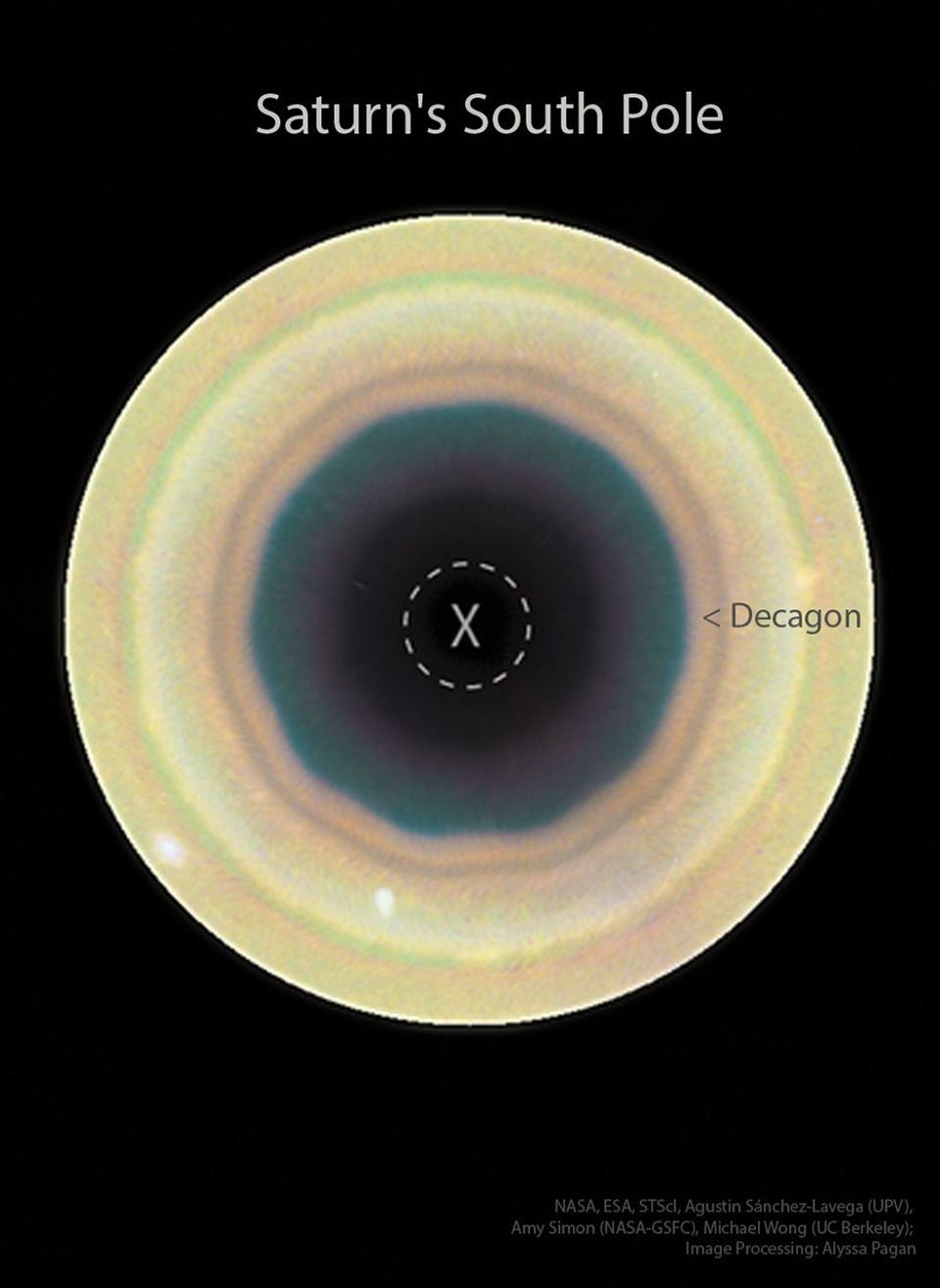
A dark field has a bright circular disk near the center. Around the center of this disk are bands. One of the bands  appear particularly geometric and appears to have 10 sides. Please see the explanation for more detailed information.

Hubble: Decagon Around Saturn’s South Pole

Explanation: Why are Saturn’s poles geometric? Saturn’s North Pole has been known to be surrounded by a hexagonal (6 sides) cloud since discovery in 1987 in data taken by NASA’s Voyager spacecrafts, which quickly flew past the ringed world in the early 1980s. Now, recent observations of Saturn by the Hubble Space Telescope reveal a slightly different geometric cloud pattern around the South Pole: a decagon (10 sides). The geometric boundaries are possibly caused by waves when the fast-moving gas away from the poles interacts with slower-moving gas closer to the poles. In the featured image composite by the Hubble taken last year, the South Pole of Saturn is marked by an X and surrounded by bands of circulating clouds. The decagon appears most prominent in the dark inner regions. The northern hexagon has proven stable for over 40 years, while the stability of the southern decagon will surely remain a topic of research.

APOD’s main NASA site is moving: From apod.nasa.gov to science.nasa.gov/apod
Tomorrow’s picture: open space

Date September 8, 2026
Credit NASAESASTScIHSTA. Sánchez-Lavega (UPV), A. Simon (NASA-GSFC), M. Wong (UC Berkeley); Processing: A. Pagan (STScI)
Authors & editors: Robert Nemiroff, Jerry Bonnell, Cecilia Chirenti, Keighley Rockcliffe
A service of: ASD at NASA / GSFC,
NASA Science Activation & Michigan Tech. U.

Source: science.nasa.gov

Posted on Leave a comment

NASA’s Hubble, Webb Find Far-out Solar System Objects ‘Remember’ Past

5 min read

NASA’s Hubble, Webb Find Far-out Solar System Objects ‘Remember’ Past

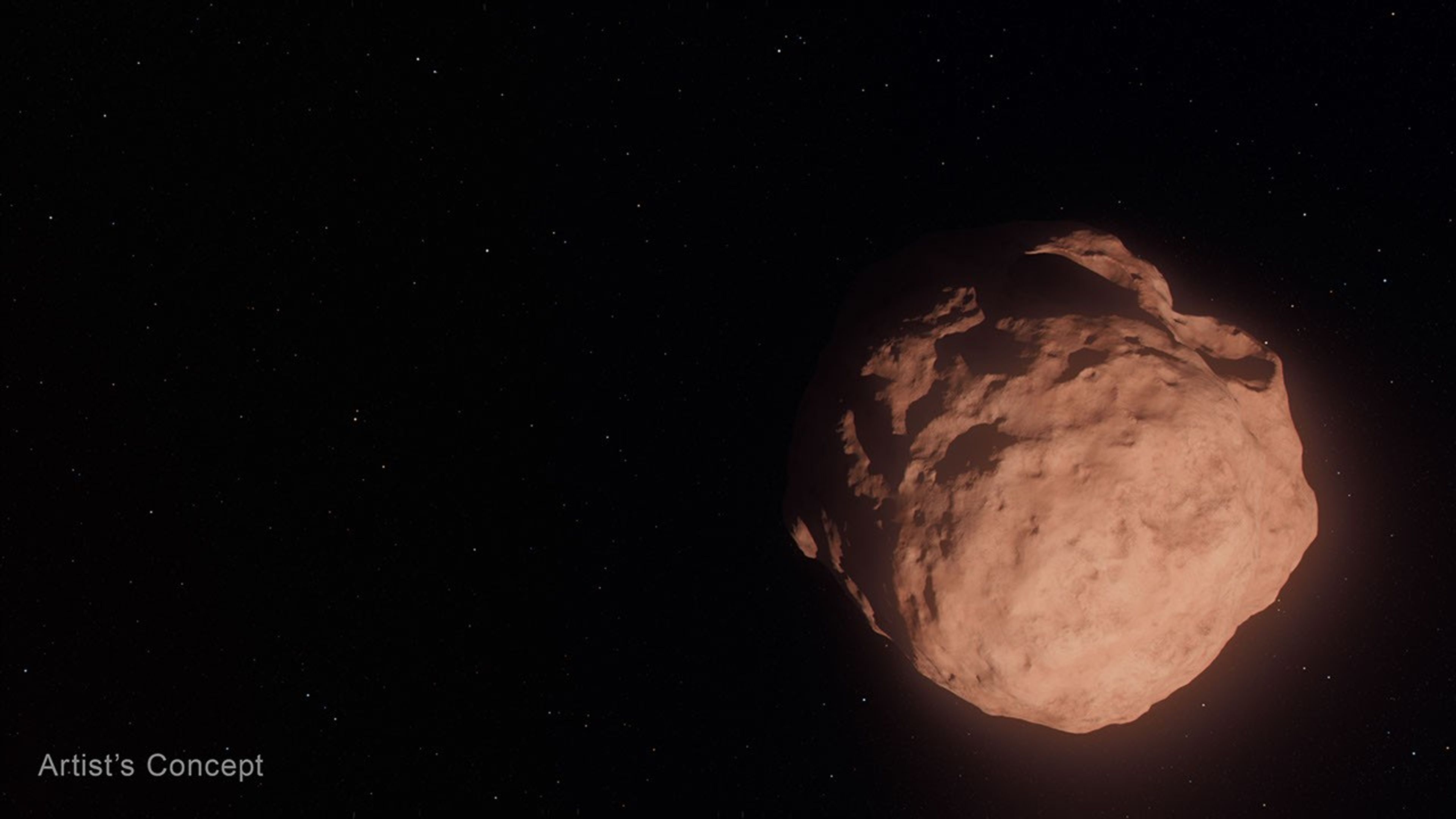
An illustration of a roughly spherical, rocky object against a black background speckled with distant, white stars. The object is the color of red clay and is pockmarked with craters and other geological scars. At the bottom left corner of the illustration in gray lettering is the label “Artist’s Concept.”
This artist’s concept depicts a Trans-Neptunian Object, a small, faint, icy body orbiting the Sun beyond the orbit of Neptune. These objects are so small that even with NASA’s Hubble and Webb space telescopes, they appear only as tiny points of light.
Artwork: NASA, ESA, Leah Hustak (STScI)

For the first time, scientists used the joint power of NASA’s Hubble and James Webb Space Telescopes to study some of the most far-flung bodies in our solar system, Trans-Neptunian Objects (TNOs). Some of these are the smallest and faintest ever directly seen. The researchers unexpectedly found fewer small TNOs than they expected, and that the colors of these bodies followed the same relationships as their larger family members.

These objects are typically small, faint, icy bodies orbiting the Sun beyond the orbit of Neptune. Most are more than 100 million times dimmer than objects visible to the unaided eye. In two complementary papers published Tuesday in The Astronomical Journal, teams analyzed the color, composition, and size distribution of 27 newly discovered tiny, dim TNOs. 

This class of small bodies offers the best view into an early stage of planet-building, when a disk of dust and pebbles in orbit around the Sun coalesced into city-sized “planetesimals” — the solid building blocks that clump together to form planets — but had not yet merged into full-sized worlds.  Beyond Neptune, this second stage never happened, leaving behind a frozen population of planetesimals.

In the deepest TNO survey to date, teams led by PhD candidates from the University of Victoria in Canada, under the guidance of the National Research Council of Canada, and Northern Arizona University in Flagstaff examined a patch of sky simultaneously with Hubble, observing the TNOs’ visible light, and Webb, observing their infrared light. The team of researchers measured the objects’ colors, which are like a fingerprint of the surface composition, as well as their sizes and determined their orbits. 

In the coordinated observations, the teams studied two different types of TNOs. The first, dynamically “cold” TNOs, are on their original, relatively circular orbits around the Sun in the plane of the solar system. The second type, dynamically “hot” TNOs, formed between the current locations of Uranus and Neptune but were pushed outward where they are today when the outer gas giants migrated early in the solar system’s history. Today they reside in highly elliptical orbits and move in and out of the plane of our solar system.

NASA’s Goddard Space Flight Center; Lead Producer: Paul Morris

Prior to these observations, astronomers thought that small TNOs from both hot and cold populations would have undergone many collisions, changing their surfaces compared to larger TNOs. But that’s not what the observations showed. Instead, the small bodies look like their larger counterparts. This implies that collisions are not changing the surfaces significantly—perhaps because there are fewer collisions than expected, or because the TNOs somehow retain their primordial, pre-collision compositions. The teams are still trying to unravel this mystery.

“You could imagine a scenario where getting knocked around and fragmented would change the surface composition, and then you would see a different surface color for tiny TNOs compared to their larger siblings. So it’s really fascinating to see that the smallest objects are somehow ‘remembering’ and preserving the history of how they were made,” said Northern Arizona University PhD candidate Anastasia Morgan, who led the study of color and composition

“These dynamically ‘hot’ TNOs retain a signature of where they were born, even though they’ve been orbitally scrambled since then,” said co-author David Trilling of Northern Arizona University.

Both the “hot” and “cold” populations seem to keep the same colors as when they were formed, with little change since the birth of the solar system. 

The Webb data also allowed researchers to measure the number of objects of each size. They found that the overall size distributions for both populations were surprisingly similar.

“It’s very interesting that the process of planetesimal formation ends up producing the same distribution of sizes for both cold and hot populations, despite forming in different regions of the early solar system. The process seems to be insensitive to disk conditions, producing similar planetesimal sizes whether the disk is hot or cold, and dense or fluffy,” said University of Victoria PhD candidate Marielle Eduardo, who led the study on size distribution

Researchers also found fewer of these very small bodies than they expected based on some planet formation models. Webb discovered 27 new, remarkably dim TNOs, one so faint it is equivalent to standing on Earth and seeing a small swarm of fireflies on the Moon. The smallest one they observed has a diameter of about 3 miles (5 kilometers), which is about five times smaller than what is possible to detect with the most sensitive ground-based telescopes.

This project would not have been possible without Hubble and Webb working together to detect and characterize these TNOs. With Hubble’s sensitivity in visible light and Webb’s in infrared, the space telescopes provide more insights than either can on its own.

The Hubble Space Telescope has been operating for over three decades and continues to make ground-breaking discoveries that shape our fundamental understanding of the universe. Hubble is a project of international cooperation between NASA and ESA (European Space Agency). NASA’s Goddard Space Flight Center in Greenbelt, Maryland, manages the telescope and mission operations. Lockheed Martin Space, based in Denver, also supports mission operations at Goddard. The Space Telescope Science Institute in Baltimore, which is operated by the Association of Universities for Research in Astronomy, conducts Hubble science operations for NASA.

The James Webb Space Telescope is the world’s premier space science observatory. Webb is solving mysteries in our solar system, looking beyond to distant worlds around other stars, and probing the mysterious structures and origins of our universe and our place in it. Webb is an international program led by NASA with its partners, ESA (European Space Agency) and CSA (Canadian Space Agency).

To learn more about NASA’s space telescopes, visit:
https://science.nasa.gov/universe

Details

Last Updated

Sep 08, 2026

Editor
Andrea Gianopoulos
Contact

Media

Claire Andreoli
NASA’s Goddard Space Flight Center
Greenbelt, Maryland
[email protected]

Ann Jenkins, Christine Pulliam
Space Telescope Science Institute
Baltimore, Maryland

Source: science.nasa.gov

Posted on Leave a comment

1,000 Museum Visitors Dive Into NASA Sea Level Science on World Ocean Day

3 min read

1,000 Museum Visitors Dive Into NASA Sea Level Science on World Ocean Day

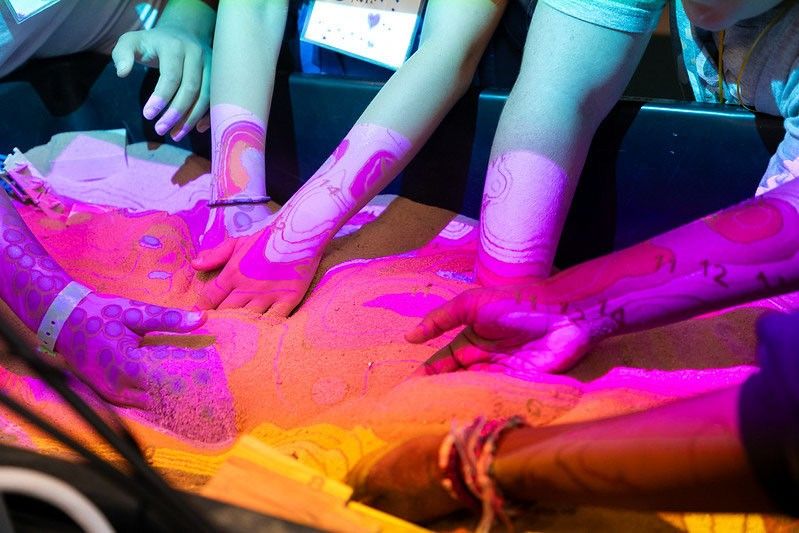
Several people place their hands and forearms on a brightly lit, abstract patterned surface under colorful fluorescent lighting.
Participants reach into an augmented reality sandbox, reshaping the terrain as projected contour lines and colors illustrate topographic features and elevation changes.
University of Georgia Marine Extension and Georgia Sea Grant

More than 1,000 visitors explored NASA sea level science firsthand during World Ocean Day at the University of Georgia Aquarium on Skidaway Island on June 6, 2026. The free event was supported by NASA’s Science Activation program through the Sea Level Education, Awareness, and Literacy (SEAL) project – a national effort that connects NASA sea level rise data with educators and coastal communities, particularly those historically underserved and already experiencing sea level impacts.

SEAL is a partnership between NASA and four NOAA Sea Grant programs working together to expand sea level rise understanding across U.S. coastal regions. By co-developing lesson plans, interactive activities, and place‑based learning experiences, SEAL helps educators engage learners with real NASA observations, models, and projections while strengthening community resilience to climate change.

During World Ocean Day, SEAL partners at Marine Extension and Georgia Sea Grant and the Coastal Equity and Resiliency Hub at Georgia Tech led hands‑on activities that brought sea level science to life. Visitors played the “Tumbling Tower” game, where removing blocks represents different community impacts from rising seas, and made “sea level friendship bracelets” that used colored glass beads to represent observed sea level rise along local coastlines.

The event also marked the debut of a new augmented reality sand box developed through SEAL. Guests shaped sand into coastal landscapes and watched NASA-informed sea level rise projections transform their creations in real time. Participants could experiment with resilience strategies, such as adding dunes or relocating homes, to see how adaptations might help communities prepare for future change.

Educators – formal, informal, home-based, and more – attending the event were able to take home four different SEAL lesson plans designed for both classrooms and informal learning settings. These materials help students explore sea level rise processes, modeling, variation, and impacts through NASA data and interactive STEM activities. SEAL aims to make all lesson plans developed through the project available online, but until then, please email Shannon Matzke to request digital copies.

“World Ocean Day is an annual tradition at the UGA Aquarium,” said Shannon Matzke, Marine Educator and Public Program Coordinator at UGA Marine Extension and Georgia Sea Grant. “With the support of NASA’s Science Activation program, this year’s event was free, which allowed us to reach more people and different audiences than we typically see. Incorporating SEAL activities made the day even more impactful for visitors – many of whom live in coastal communities already experiencing the effects of sea level rise.”

The SEAL project is supported by NASA cooperative agreement award number NNH21ZDA001N-SCIACT and is part of the NASA Science Activation Program portfolio, which connects learners with authentic NASA science experiences through partnerships with educators and community organizations.

Source: science.nasa.gov

Posted on Leave a comment

NASA Technique for Manipulating Satellite Photos Now Reveals Ancient Images  

3 min read

Preparations for Next Moonwalk Simulations Underway (and Underwater)

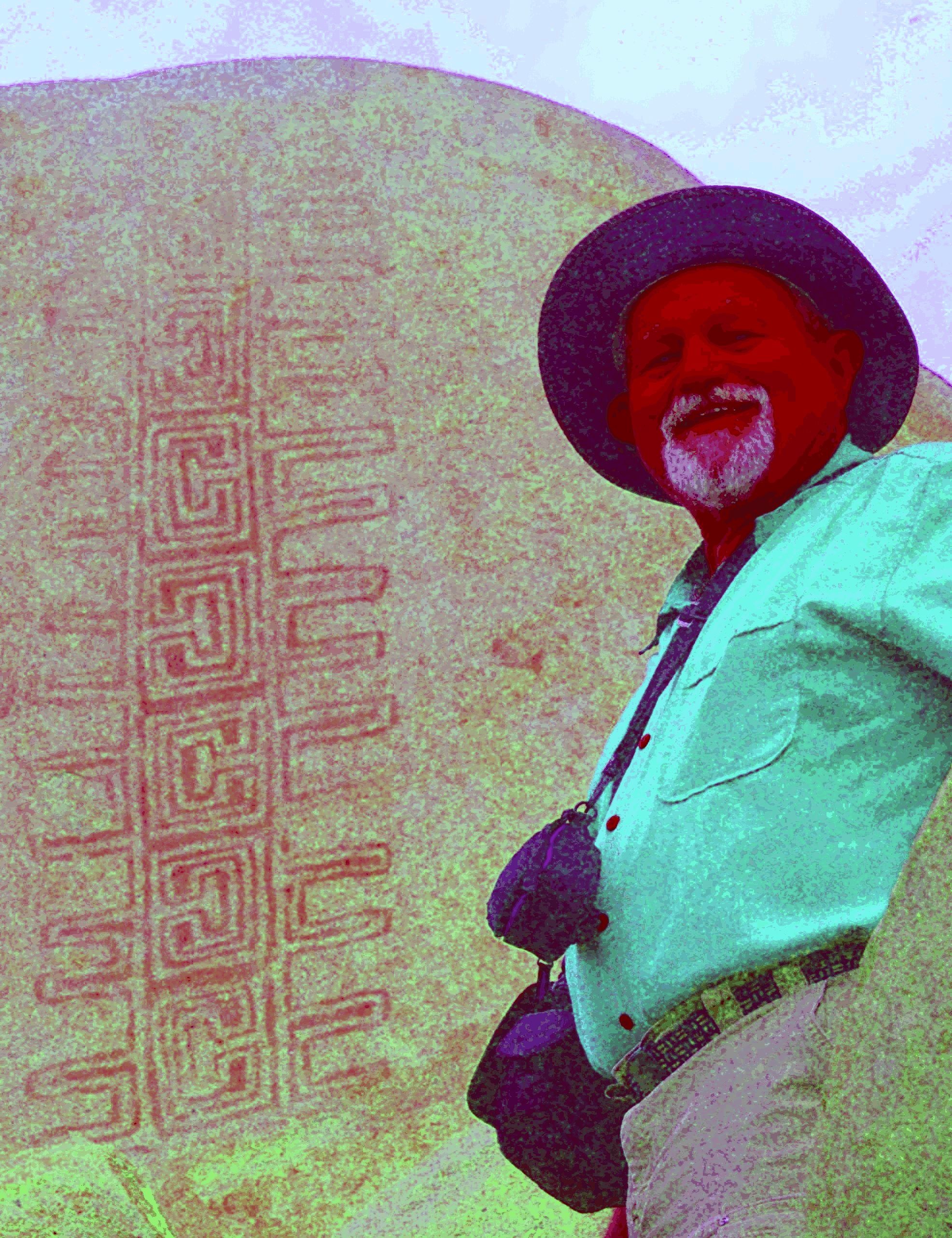
A man stands in front of a rock with art on it, the colors are intense and exaggerated revealing an intricate design in the rock's surface.
Jon Harman poses in front of an example of the Rancho Bernardo style of Native American artwork that’s barely visible until Dstretch is applied. 
Credit: Jon Harman 

High in the central tower in the ancient Cambodian temple of Angkor Wat, paintings depict horseback riders and a traditional musical ensemble. Thousands of visitors pass these images daily without noticing, because they’re faded to the point of invisibility. 

They were discovered between 2010 and 2012, along with about 200 other paintings throughout the complex, by an archaeologist using a method conceived at NASA’s Jet Propulsion Laboratory in Southern California. 

The technique, known as decorrelation stretch, heightens contrasts in digital imagery, making features easier to spot. It is especially popular for studying ancient rock art, partly due to the chance intersection of one man’s hobby with his professional background. 

Around 2005, rock art enthusiast Jon Harman saw NASA images depicting the Martian surface with and without the application of decorrelation stretch. Seeing how much detail the technique revealed, Harman, now retired in Pacifica, California, understood the implication for studying ancient, faded images. 

He also worked in medical imaging. “I Googled it and found a NASA paper that explained how to do the algorithm,” he said. “I knew from my medical imaging experience that I could do it, so I did.” 

The paper was written in 1996 by Ronald Alley, a JPL employee developing applications for the Advanced Spaceborne Thermal Emission and Reflection Radiometer (ASTER), a Japanese imaging instrument on NASA’s Terra satellite. One of Alley’s former supervisors at JPL had coinvented decorrelation stretch, and Alley had recognized its potential for gleaning information from ASTER imagery.  

Harman made his plug-in for use with ImageJ, an open-source program developed by the National Institutes of Health.  


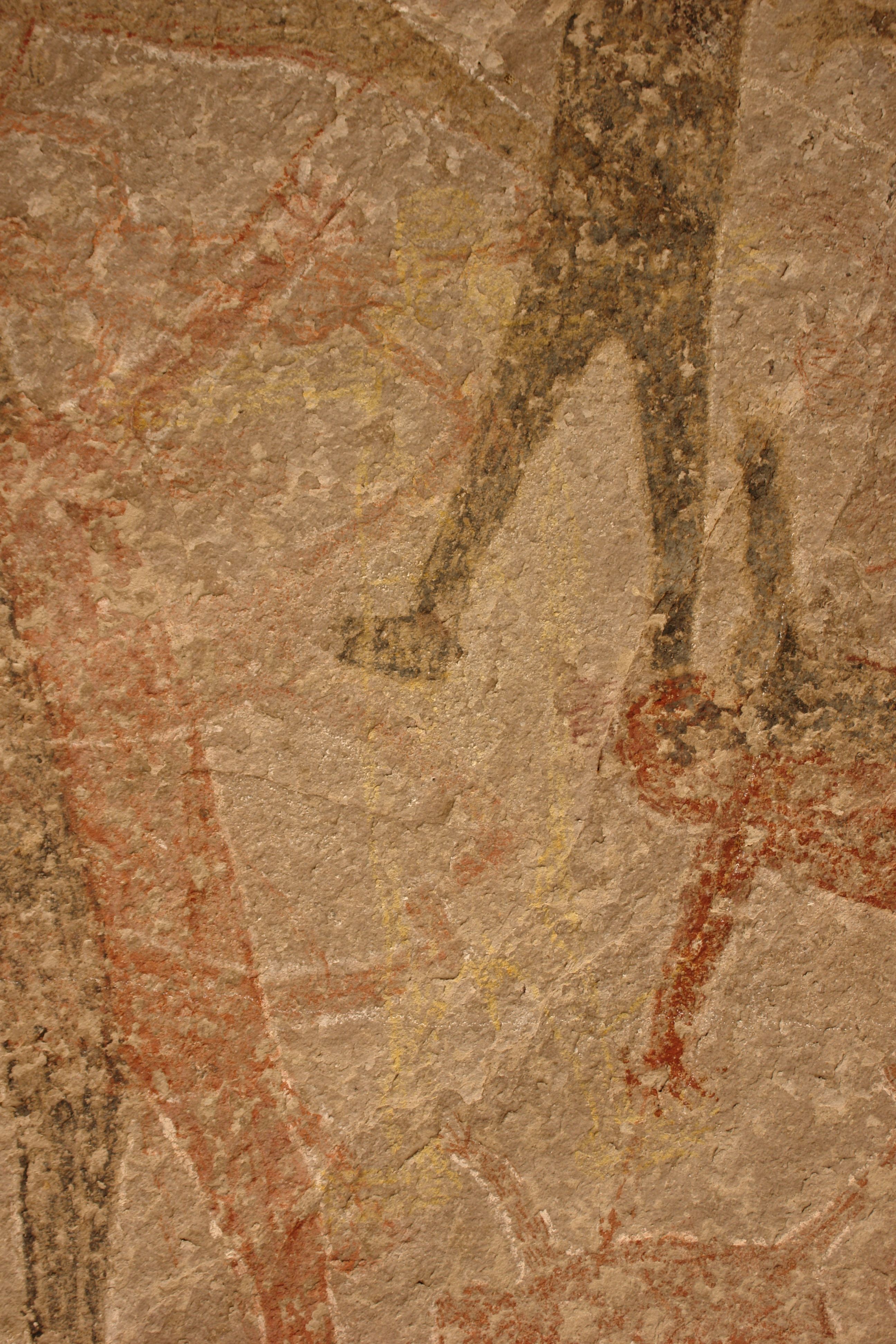
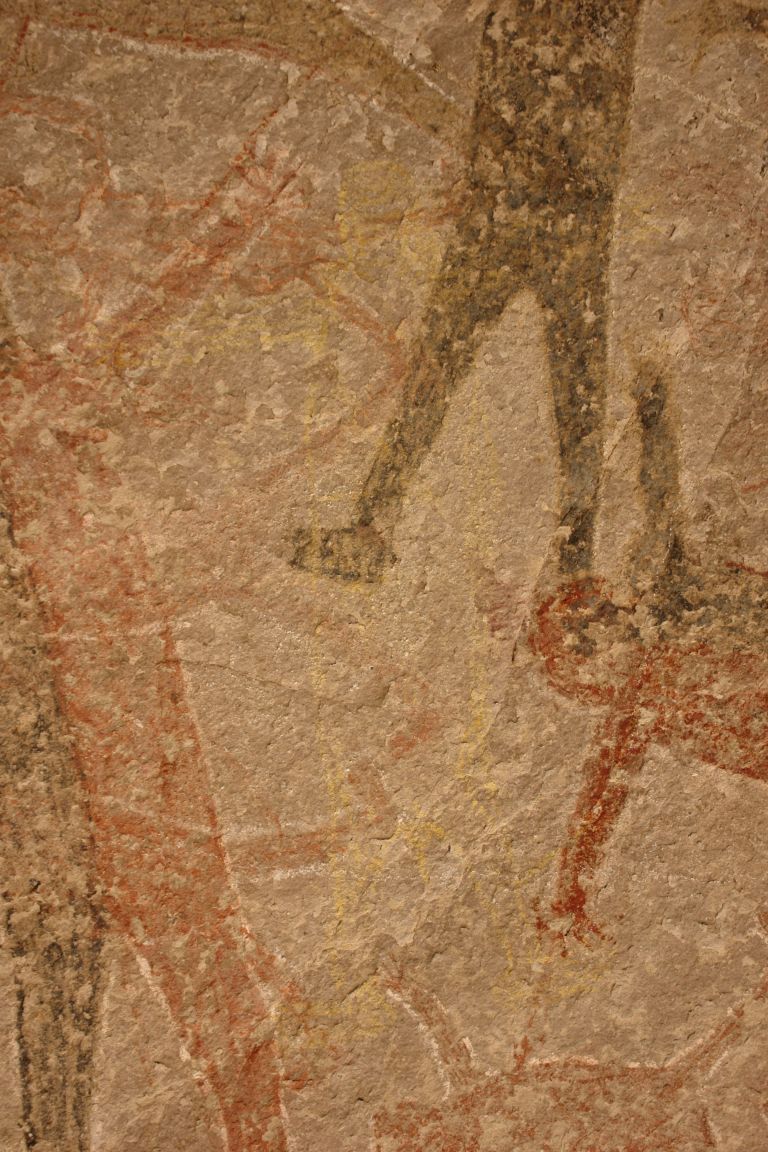
before
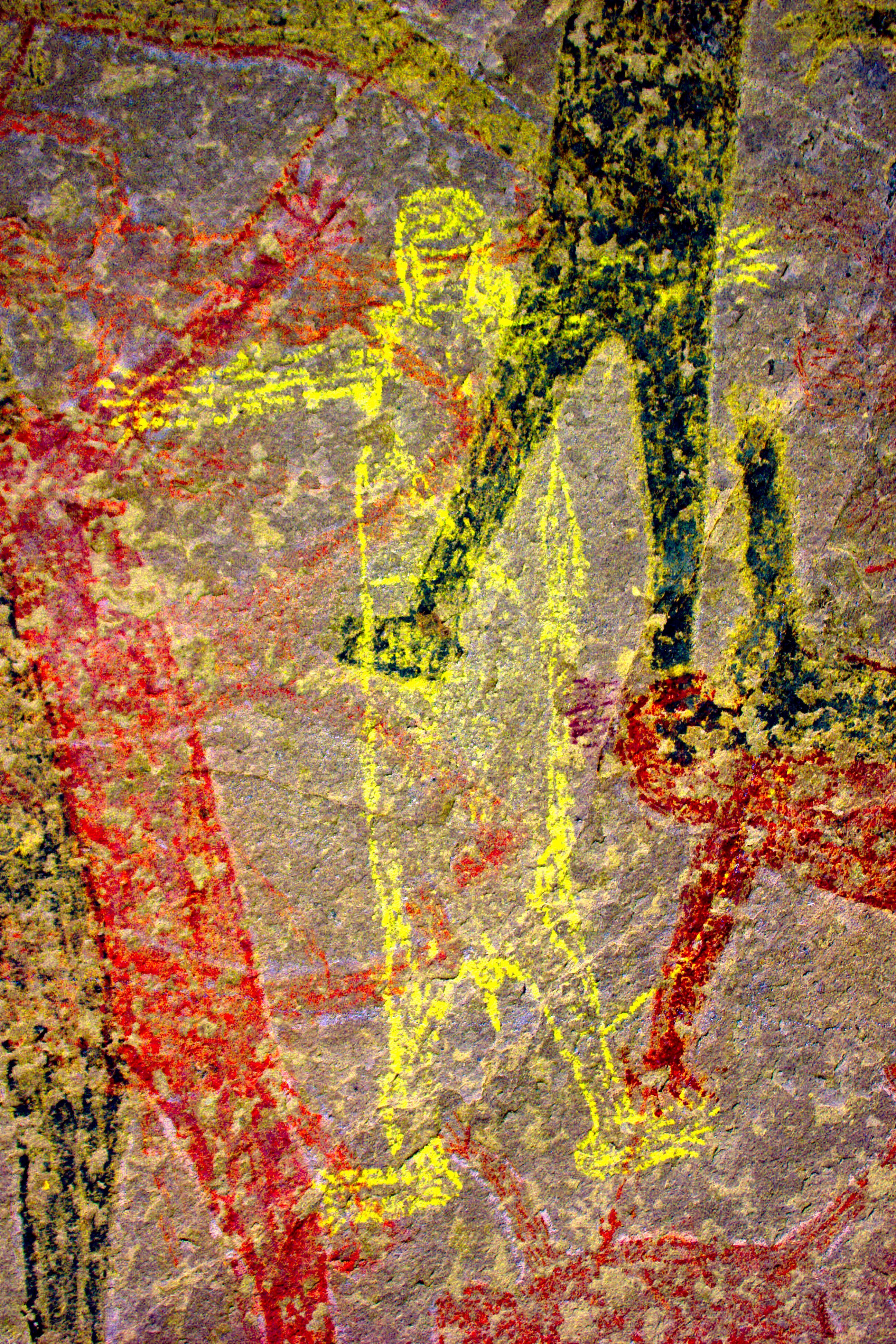
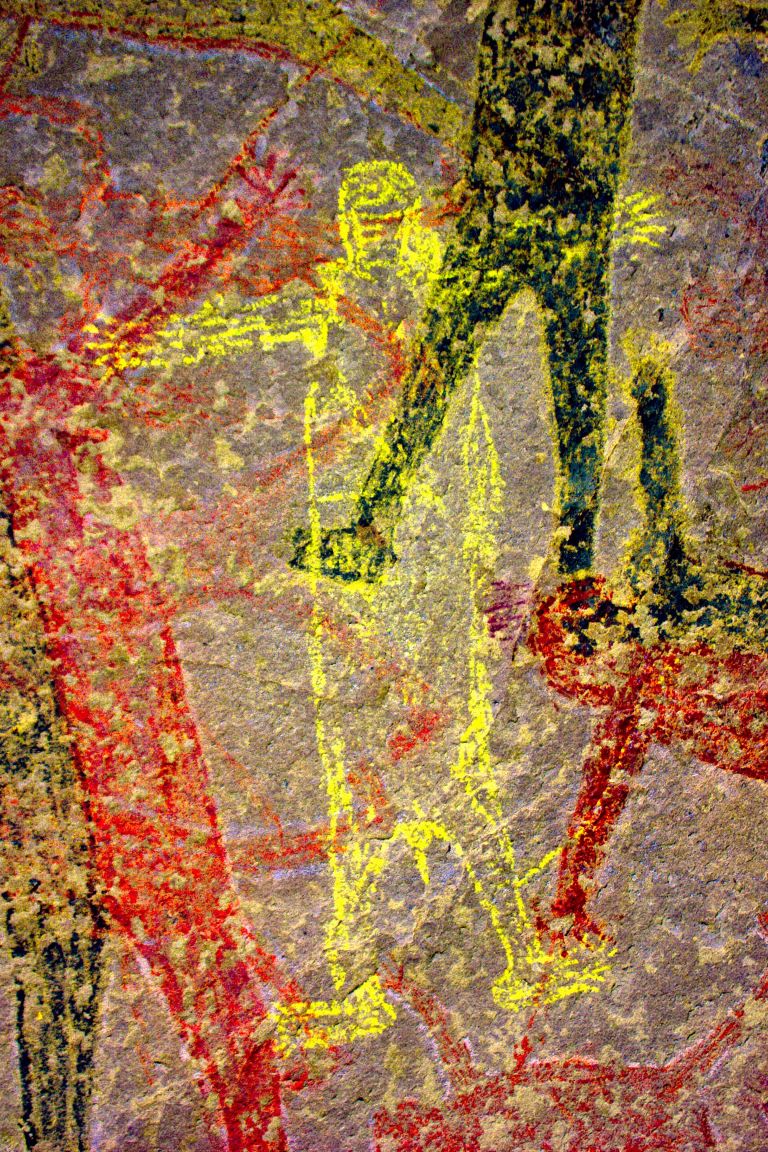
after

A wall with a series of faded humanoid figures painted on it.

A new yellow figure emerges from behind the other after the dstretch algorithm is applied

A wall with a series of faded humanoid figures painted on it.
A new yellow figure emerges from behind the other after the dstretch algorithm is applied

before

after

Before and After

Dstretch applied to Cave of San Borjitas in Baja California, Mexico


As Jon Harman was developing the Dstretch plug-in, he applied it to this image from the Cave of San Borjitas in Baja California, Mexico. When the yellow figure appeared in the middle of the picture, he knew he had something useful. Credit: Jon Harman 

He said he fulfills about 200 requests for Dstretch per year. Around 2010, he also created smartphone apps that use a shortcut to mimic decorrelation stretch. The apps have been downloaded thousands of times, and papers have been published describing Dstretch’s usefulness in archaeology. 

It has been used to spot and clarify imagery at ancient sites under a cliff in Norway, in an Egyptian tomb, at a park in Canada, and in many other locations. It has also helped archaeologists find buried remains of ancient Greek buildings and examine tattoos on mummified human remains, among its non-rock-art applications.  

Harman said he was not surprised Dstretch found wide use in the rock art community. “But I’ve been surprised by a lot of the different applications people have found. So that’s been cool.”  

Details

Last Updated

Sep 08, 2026

Source: www.nasa.gov

Posted on Leave a comment

Superbubble in the Large Magellanic Cloud

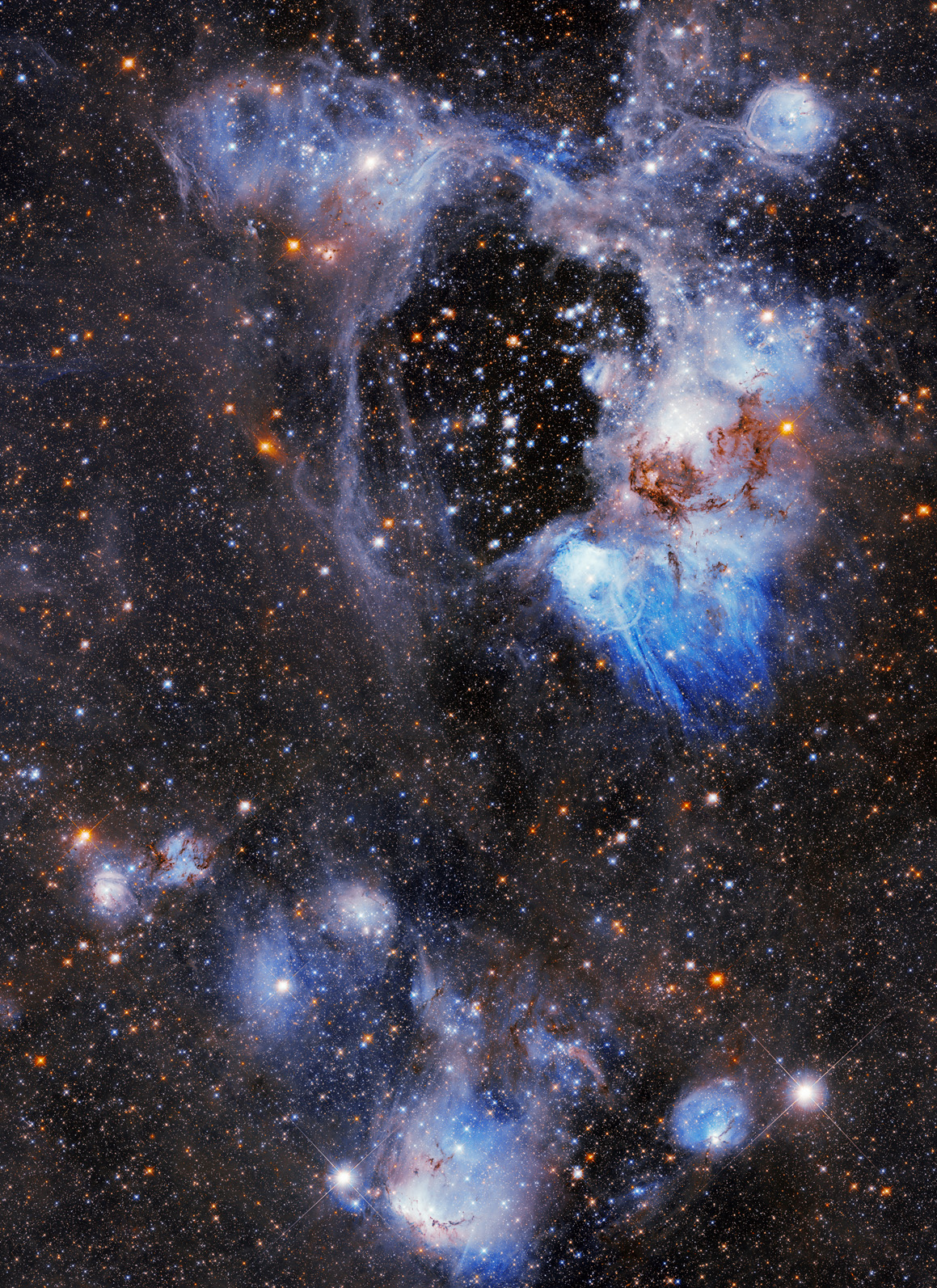
Blue and orange stars shine through a wispy bubble of gas; the center is mostly clear, but blue and gray tendrils snake throughout most of the rest of the image. The background of the image is filled with other stars.
NASA, ESA/Hubble, D. Gouliermis

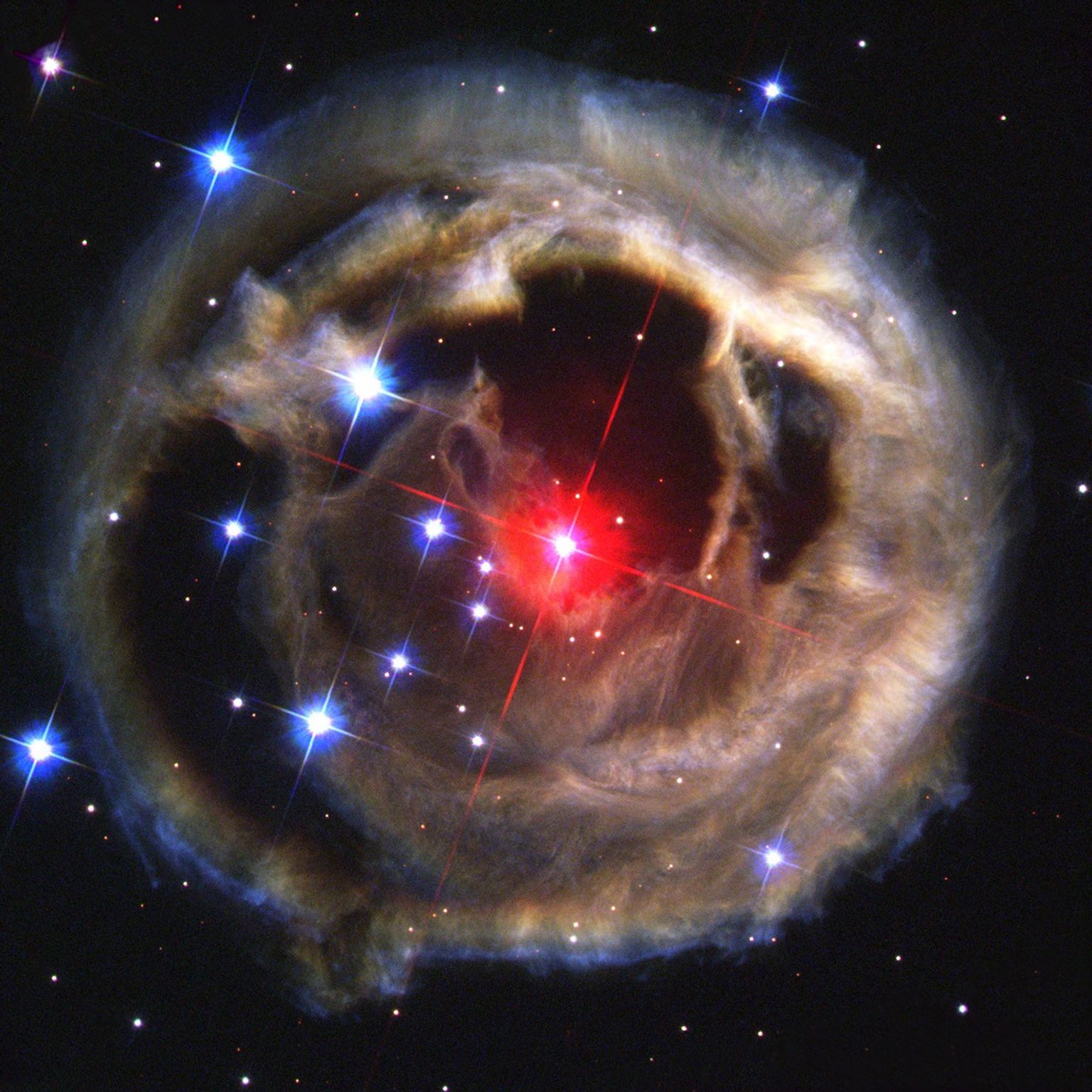
NASA’s Hubble Space Telescope captures a photogenic nebula, N44, in the Large Magellanic Cloud in this Sept. 3, 2026, image. N44 is dominated by two features: a vast central void and a shell of dense, dusty gas. The central void is a ‘superbubble’ spanning roughly 210 by 140 light-years across. The glittering stars at the center of the void are responsible for its creation; through their powerful stellar winds and explosive supernovae, these stars expelled much of the gas from which they were born.

Read more about this cosmic vista.

Image credit: NASA, ESA/Hubble, D. Gouliermis

Source: www.nasa.gov

Posted on Leave a comment

NASA Calls for Proposals to Accelerate Lunar Surface Technologies 

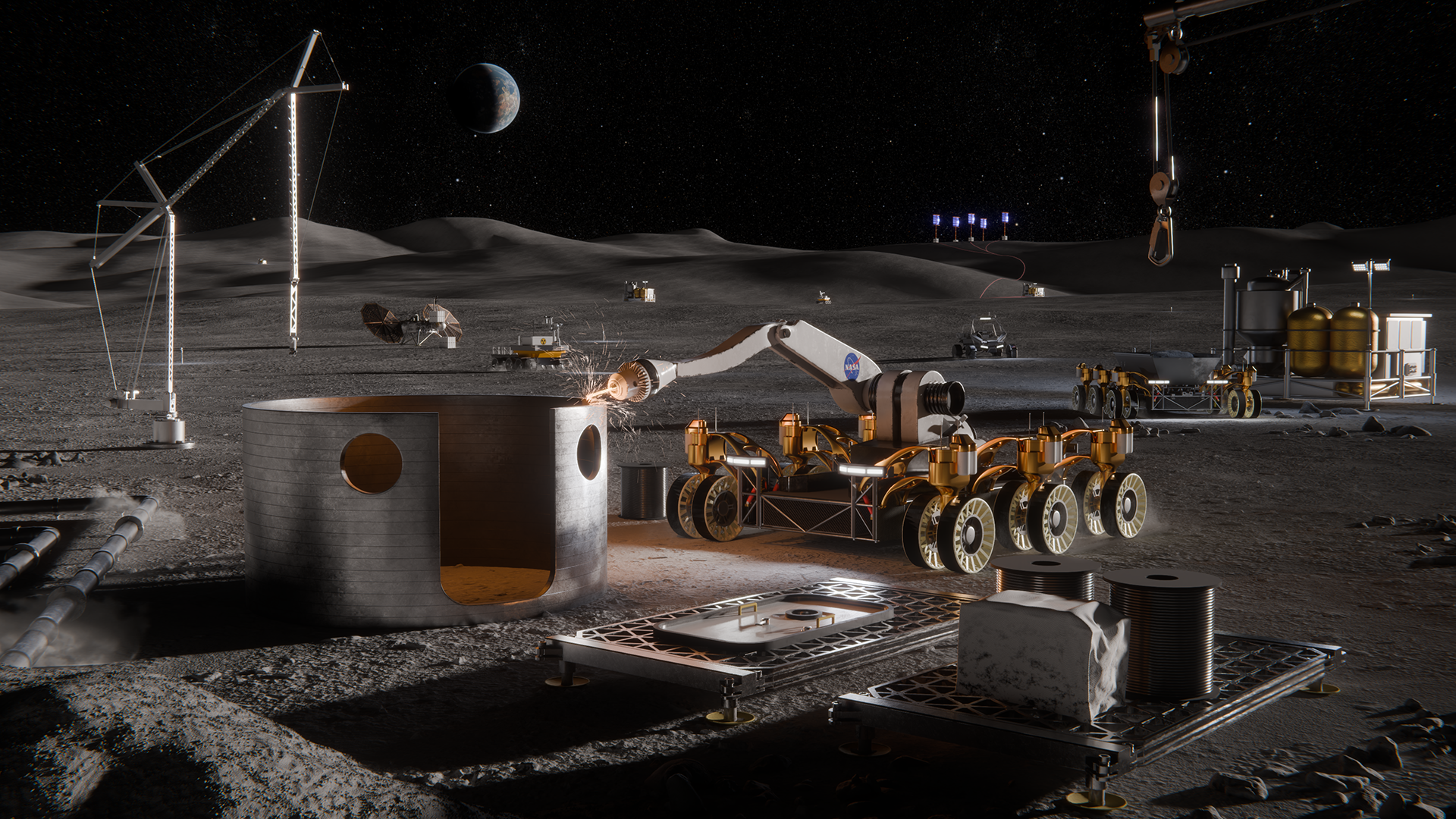
Artistic concept of lunar surface technologies and infrastructure capabilities, including in-situ resource utilization oxygen production systems, surface power systems, in-space manufacturing tools, and advanced nanomaterials production.
Credit: NASA

NASA is seeking proposals to advance the technology and infrastructure needed to explore the Moon and establish a Moon Base in the lunar South Pole region.

Announced on Tuesday, Sept. 8, the solicitation targets capability gaps, including power generation, oxygen extraction, and producing materials on the Moon required for construction and operations. These technologies are essential to making humanity’s next great leap in lunar exploration.

“NASA is accelerating the development of key technologies and closing critical gaps needed for long-term human exploration at the Moon,” said Greg Stover, director of NASA’s Advanced Research and Technology Division. “Partnering with industry will strengthen the U.S. industrial base as we mature the capabilities and infrastructure needed for a sustainable lunar presence.”

The NextSTEP-3 Broad Agency Announcement Appendix A: Lunar Enabling Infrastructure Accelerator solicitation aims to mature and demonstrate capabilities in five areas:

  • Vertical solar array technology that can provide consistent power generation, management, distribution, and energy storage.
  • In-situ resource utilization oxygen from regolith production to extract usable oxygen molecularly bonded to rock and dust covering the Moon’s surface.
  • Radioisotope Stirling generator, a type of nuclear energy technology that uses heat from fissile materials to produce electric power for operating spacecraft systems in the darkest, dustiest, and most remote places.
  • In-space advanced manufacturing to reduce reliance on resupply missions from Earth and to optimize mission flexibility and resilience on the Moon.
  • Innovative nanomaterials production to advance the commercial availability and quality of nanomaterials that can be used in lunar exploration.

The solicitation intends to cultivate U.S.-led capabilities while maintaining full and open competition among private industry, academic institutions, and not‑for‑profit entities, as well as international partners participating through U.S.-led teams. 

NASA may apply insights gained from the resulting contracts of this solicitation, such as technical data, and demonstration results, to shape future acquisition strategies.  

To learn more about NextSTEP-3, visit:

https://go.nasa.gov/4x20o3t

-end-

Rob Margetta
Headquarters, Washington
202-358-0918
[email protected]

Details

Last Updated

Sep 08, 2026

Source: www.nasa.gov

Posted on Leave a comment

From the Corps to the Cosmos, featuring Jaden Caradine

Jaden Caradine knew he wanted to be an engineer at eight years old. He just took a winding road to get there.

Before he enrolled at Embry-Riddle Aeronautical University, before he discovered the field that would become his focus, and before he landed a Pathways internship at NASA’s Langley Research Center in Hampton, Virginia, Caradine spent five years as a mechanic in the United States Marine Corps, four of them stationed in Japan. It was a deliberate detour, one that shaped how he approaches everything since.

“I’ve kind of always known I wanted to be an engineer,” he says. “I just had to figure out what kind.”

Jaden Caradine, NASA Pathways intern, at NASA Langley Research Center
NASA Pathways intern Jaden Caradine
Credit: NASA

Finding the Overlap

Caradine grew up in the Salt Lake City area, raised by a mother who put him on a snowboard at four and on a rock face not long after. He was the kind of kid who learned to love science not for its own sake, but for what it could do. “Math is an enabling skill,” he says. “It’s not about doing the math. Math has a purpose and it’s useful.”

By the time someone asked young Jaden what he wanted to be, the answer was immediate. “I was building Legos,” he says, “and I just thought — I want to build stuff. I can’t really see myself being anything other than an engineer.”

Right out of high school, Caradine enlisted in the Marines, trained as a mechanic, and shipped out to Japan. During those five years, between the technical work and the distance from home, he started reading books on decision-making, career planning, and long-term thinking. He found a framework he keeps coming back to: ikigai, a Japanese concept that maps the intersection of what you’re good at, what you enjoy, what the world needs, and what you’re paid to do.

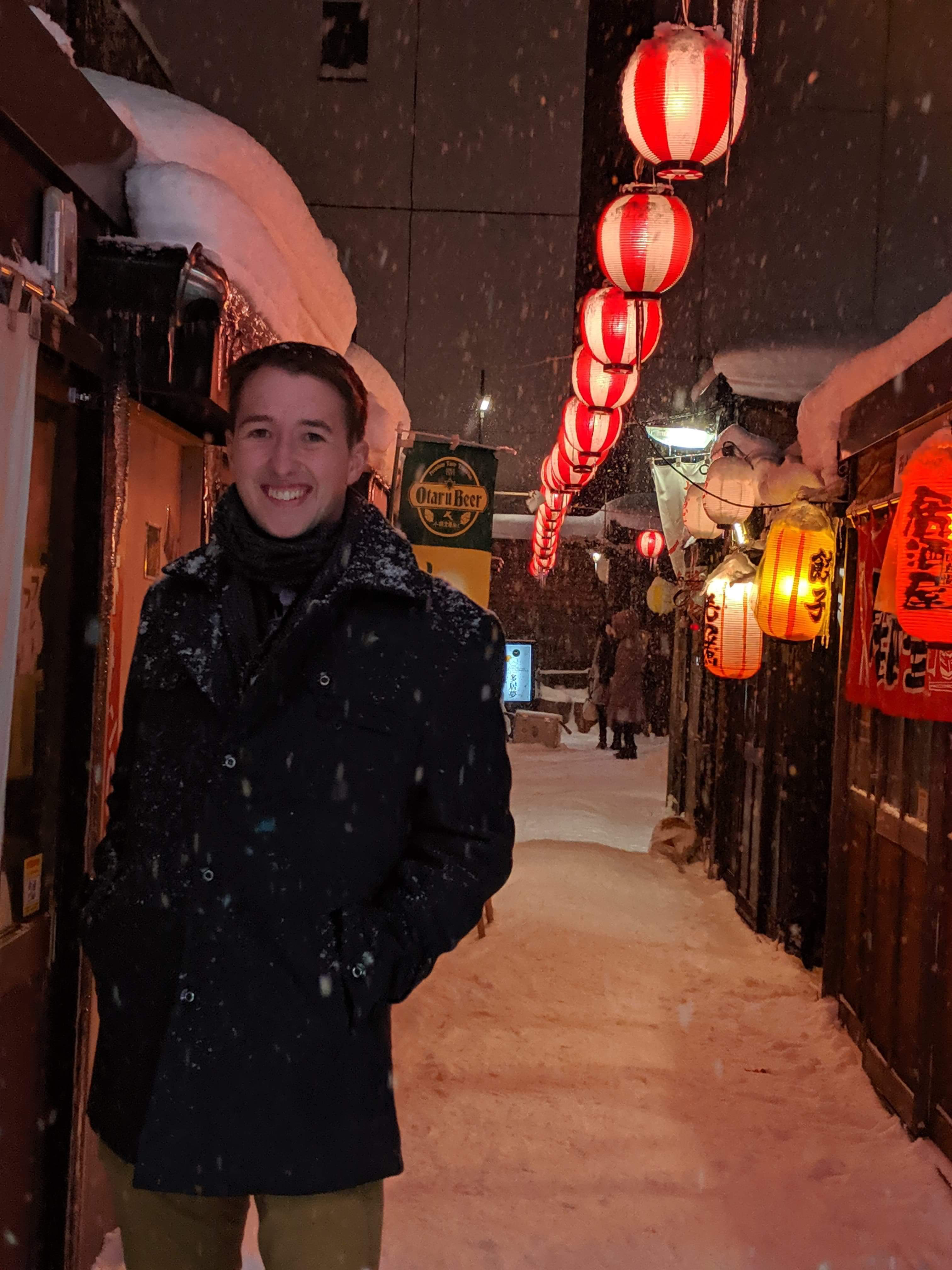
Jaden Caradine at the Sapporo Snow Festival in Hokkaido, Japan, during his service as a U.S. Marine
Caradine at the Sapporo Snow Festival in Hokkaido, Japan, while serving as a U.S. Marine
Credit: Jaden Caradine

“Your ikigai is the thing where all of those overlap,” he says. Engineering was already in the picture. The question was what kind.

Chasing the Signal

The answer arrived through research and a company Caradine stumbled on while scanning the landscape of emerging aerospace technology. They were using magnets to spin a launch system to 14,000 or 15,000 RPM and release small satellites into orbit, recovering the energy on the way down through the same magnetic system. “I thought that was awesome,” he recalls. “So, I started looking into aerospace engineering, and it was a good fit.”

Once he had the field, the destination wasn’t hard to find. Caradine transferred to Embry-Riddle Aeronautical University’s Daytona Beach campus to study aerospace engineering and immediately started showing up everywhere he could — satellite conferences at Kennedy Space Center, industry events in Orlando, small satellite gatherings back in Salt Lake City. “I went to all the career fairs, even though I wasn’t looking for a job yet,” he says. “I just wanted to learn as much as I could, as fast as I could.”

At every NASA booth, he asked questions. He learned about Pathways, the program that places undergraduate and graduate students at NASA centers with the potential to convert to full-time civil service positions, but he waited a year to apply. “I hadn’t really done the things I wanted to do in order to write a strong application yet,” he says. He wrote the next application with the intention of using it as a practice run. He got in.

His reason for choosing NASA over industry was simple and firm. “NASA doesn’t work for profit,” he says. “We’re here to remove barriers so that industry can eventually do the things they weren’t able to do before.”


“Human beings are far more capable than we give ourselves credit for. A journey of a thousand miles starts with a single step and can only be taken one step at a time.”


Work Worth Doing

At NASA Langley, Caradine is part of the Systems Analysis and Concepts Directorate, where “we help agency leaders figure out why they should make certain decisions, especially those that have lots of moving parts,” he explains. Specifically, he works with the in-space servicing, assembly, and manufacturing (ISAM) team, a group focused on the emerging field of building and maintaining infrastructure in space, rather than simply launching and discarding it.

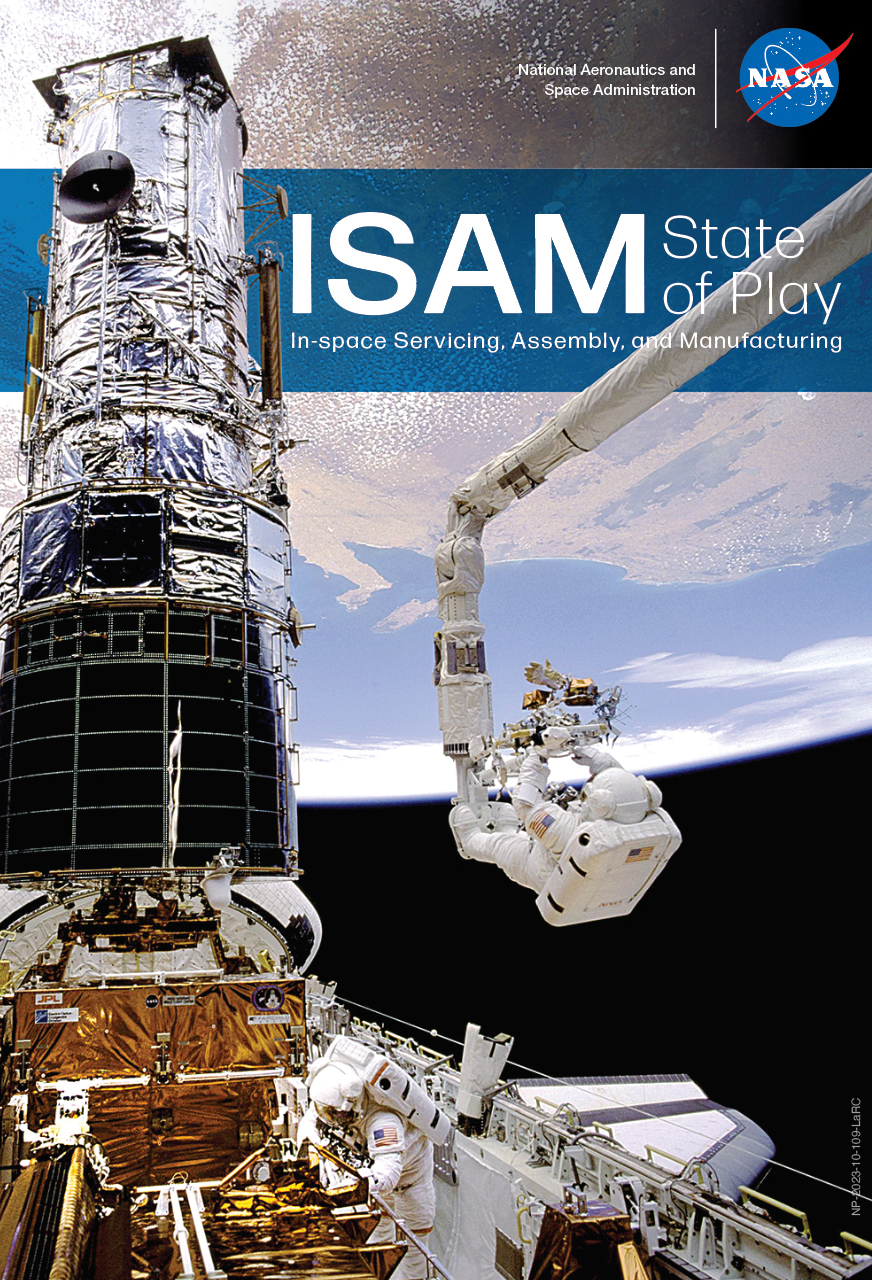
A major part of his summer was curating the State of Play, a comprehensive document that consolidates everything happening in the ISAM sector across government, academia, and industry into a single, navigable resource.

“Jaden joined the team and immediately contributed to this year’s State of Play update,” says Dale Arney, aerospace engineer and Caradine’s mentor. “He also created an automated tool that will help the team create future updates more quickly.”  

Cover of NASA's ISAM State of Play document, a survey of in-space servicing, assembly, and manufacturing capabilities across industry, academia, and government
The ISAM State of Play document is a survey of past, present, and near-future ISAM capabilities across industry, academia, and government agencies.
Credit: NASA

That tool scrapes aerospace news from across the web, compiles relevant updates into organized tables, and produces a readable summary on a regular cadence. “It kind of replaced the need for everyone on the team to spend 30 or 40 minutes every day scrolling through news to keep up,” he says.

“Jaden was constantly looking for ways to improve himself, the team, and our products,” Arney adds. “He was eager to take the lead in trying a number of new processes and ideas to try to make them work for us.” 

No Silos

The thing that surprised Caradine most about NASA Langley had nothing to do with the technical work. He had expected some departmental siloing that could develop in large organizations, where people become experts in narrow areas with limited cross-pollination among teams.

“That’s not something I’ve experienced here,” he says. “We all talk to each other, across all teams. We share resources. We collaborate quite extensively.” He describes a culture that expects everyone to engage with the whole problem, not just their corner of it. “Everyone kind of bounces around on different teams to learn the whole aspect of the problem and support each other.”

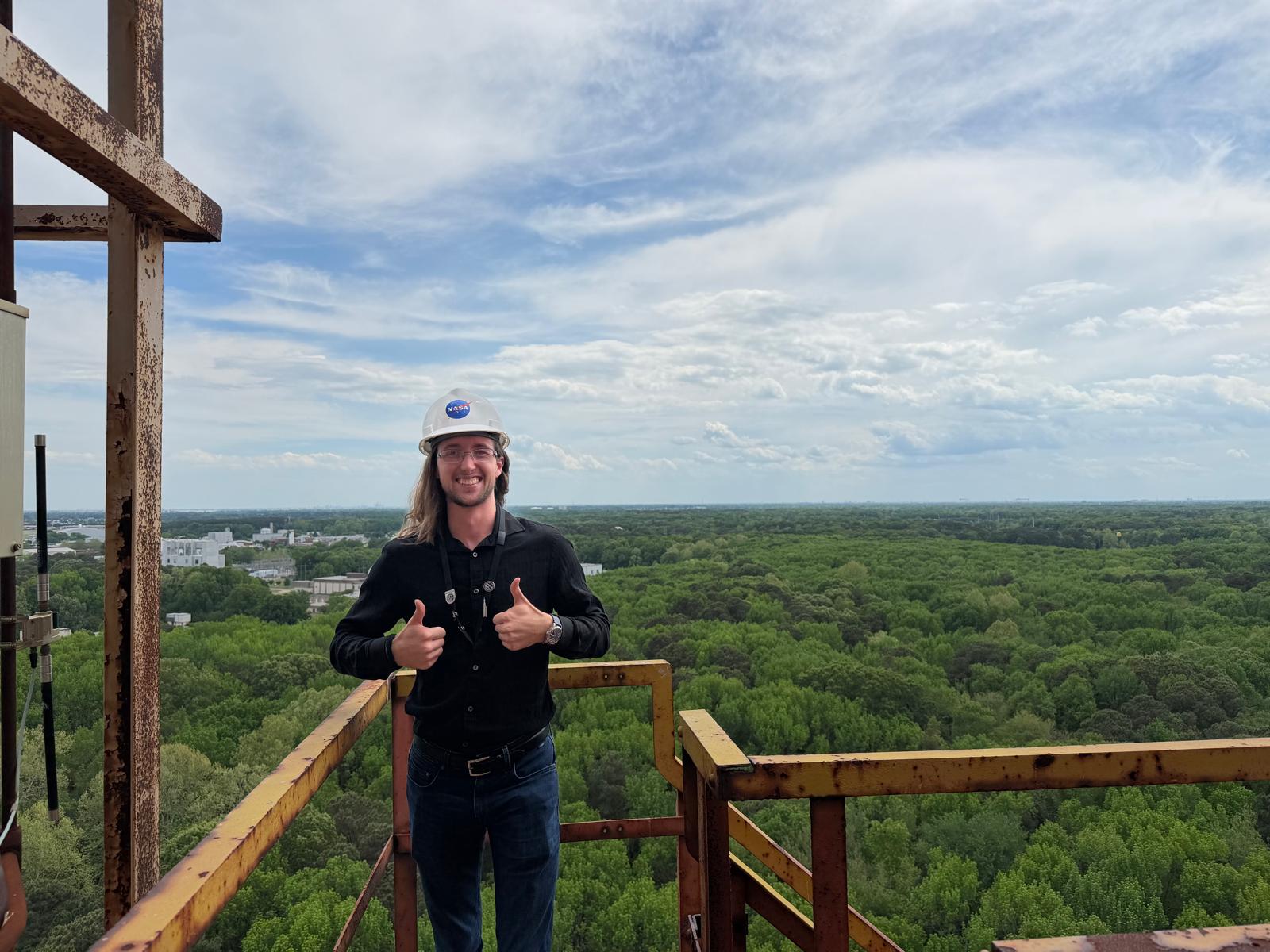
Jaden Caradine standing atop the gantry at NASA Langley's Impact Dynamics Facility
Caradine at NASA Langley’s Impact Dynamics Facility, enjoying the view at the top of the gantry
Credit: NASA

For anyone considering the Pathways program, his advice is direct. “Do it,” he says. “Human beings are far more capable than we give ourselves credit for. If it seems like too much, break it down. A journey of a thousand miles starts with a single step and can only be taken one step at a time.”

Caradine heads back to Embry-Riddle as a junior this fall, with plans to return to Langley next summer. Grad school is on the horizon, and he’s exploring programs that nurture important analysis skills for SMAB, including decision, strategic, and systems analysis.

“Before coming here, I was trying to do everything and cast a wide net,” he says. “Now I know what I need to know how to do. That’ll give me the opportunity to focus my efforts on the high-value skill sets.”

On Caradine’s Sci-Fi Shelf

The Sirens of Titan by Kurt Vonnegut

Dungeon Crawler Carl by Matt Dinniman

Caradine’s instinct runs more toward fantasy than science fiction, but this one, he says, hits something real.

“I enjoy the leveling aspect — constantly improving, constantly getting better. In books it might be physical strength, but in reality, strength takes on many different forms. Constant improvement is quite rewarding in real life, as it is in books.”

The audiobook production, he adds, is its own experience: full sound design, character actors, the works. “It’s like listening to a movie.”

The team also recently convinced him to start Dune, by Frank Herbert. He’s about halfway through.


Part of the Systems Analysis and Concepts Directorate at NASA’s Langley Research Center.
Learn more about our work by visiting our website.

Source: www.nasa.gov

Posted on Leave a comment

NASA Uses Subscale Aircraft to Accelerate Flight Innovation

4 Min Read

NASA Uses Subscale Aircraft to Accelerate Flight Innovation

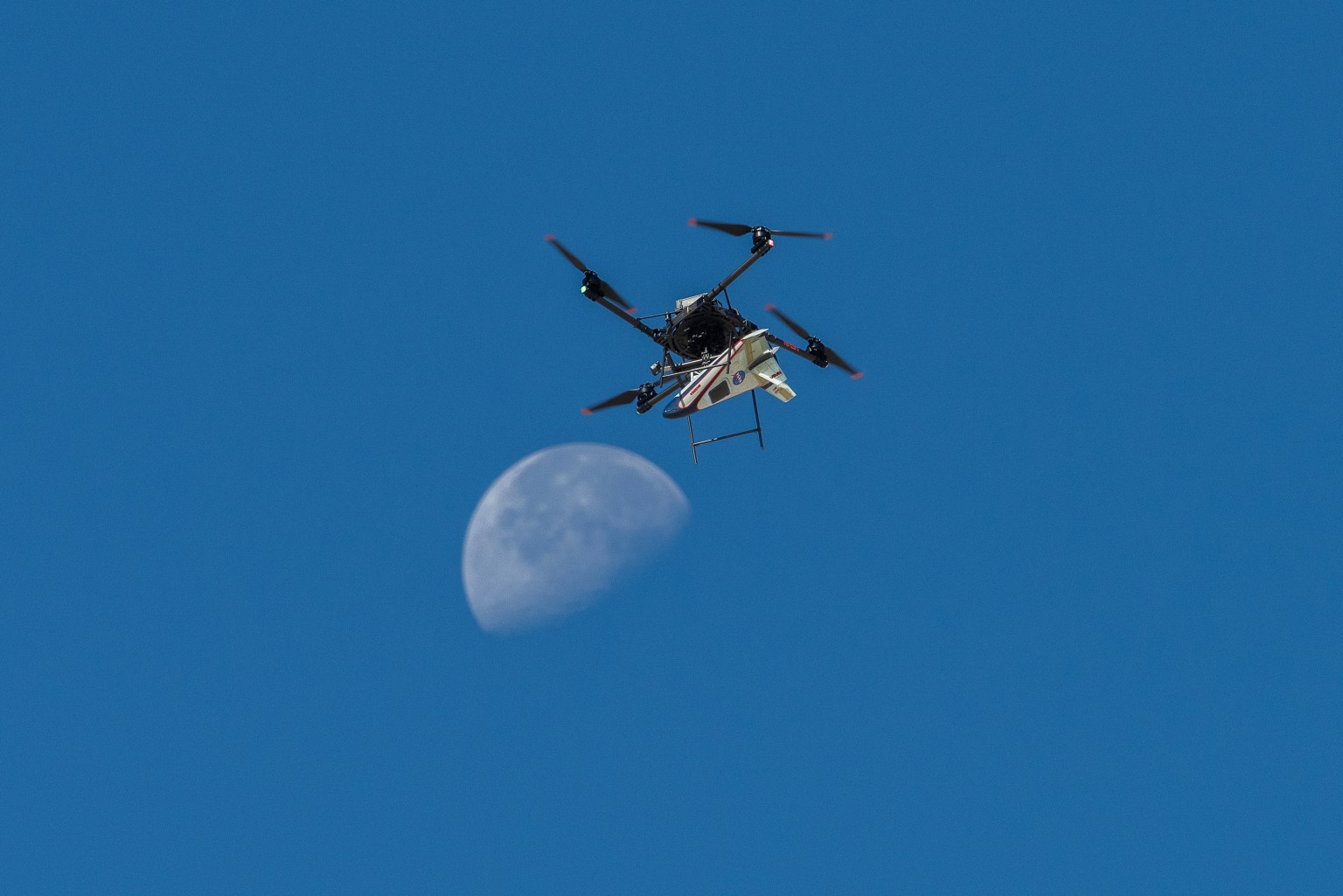
A white, blue, and red probe attached to a rotor with four blades flies in the blue sky, just above the Moon.

An atmospheric probe model attached upside down to a quad rotor remotely piloted aircraft ascends with the Moon visible on Oct. 22, 2024. The quad rotor aircraft released the probe above Rogers Dry Lake, a flight area adjacent NASA’s Armstrong Flight Research Center in Edwards, California. The probe was designed and built at the center.

Credits:
NASA/Steve Freeman

Testing new aerospace concepts in flight remains one of NASA’s most effective ways to advance knowledge and reduce risk.

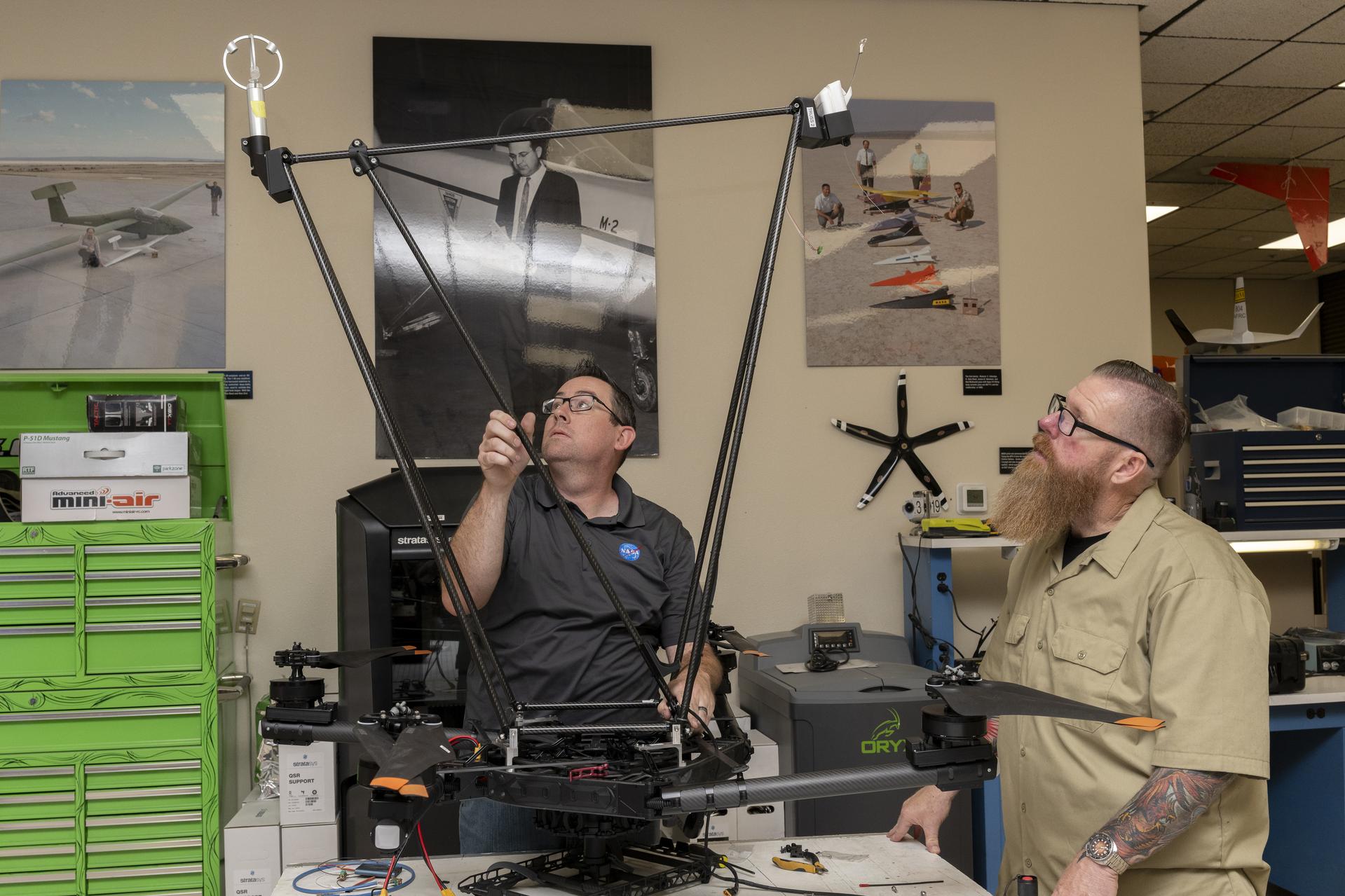
The Dale Reed Subscale Flight Research Laboratory at NASA’s Armstrong Flight Research Center in Edwards, California, supports this mission by using small, remotely piloted and autonomous aircraft as cost‑effective platforms to mature innovative ideas, accelerate learning, and enable smoother transitions to full‑scale flight.

When experiments require a flight platform, several NASA remotely piloted aircraft are available: the Alta‑X quadrotor; the Dryden Remotely Operated Integrated Drone (DROID) with its 10‑foot wingspan; and the Multi‑Use Cub, a 14‑foot‑span fixed‑wing aircraft with an expandable payload capacity for flight experiments. For electric vertical takeoff and landing testing, the HQ‑90 quadrotor provides an additional option.

Once aircraft and experiments are cleared for operations, laboratory pilots support the mission, including ground operations and flight activities.

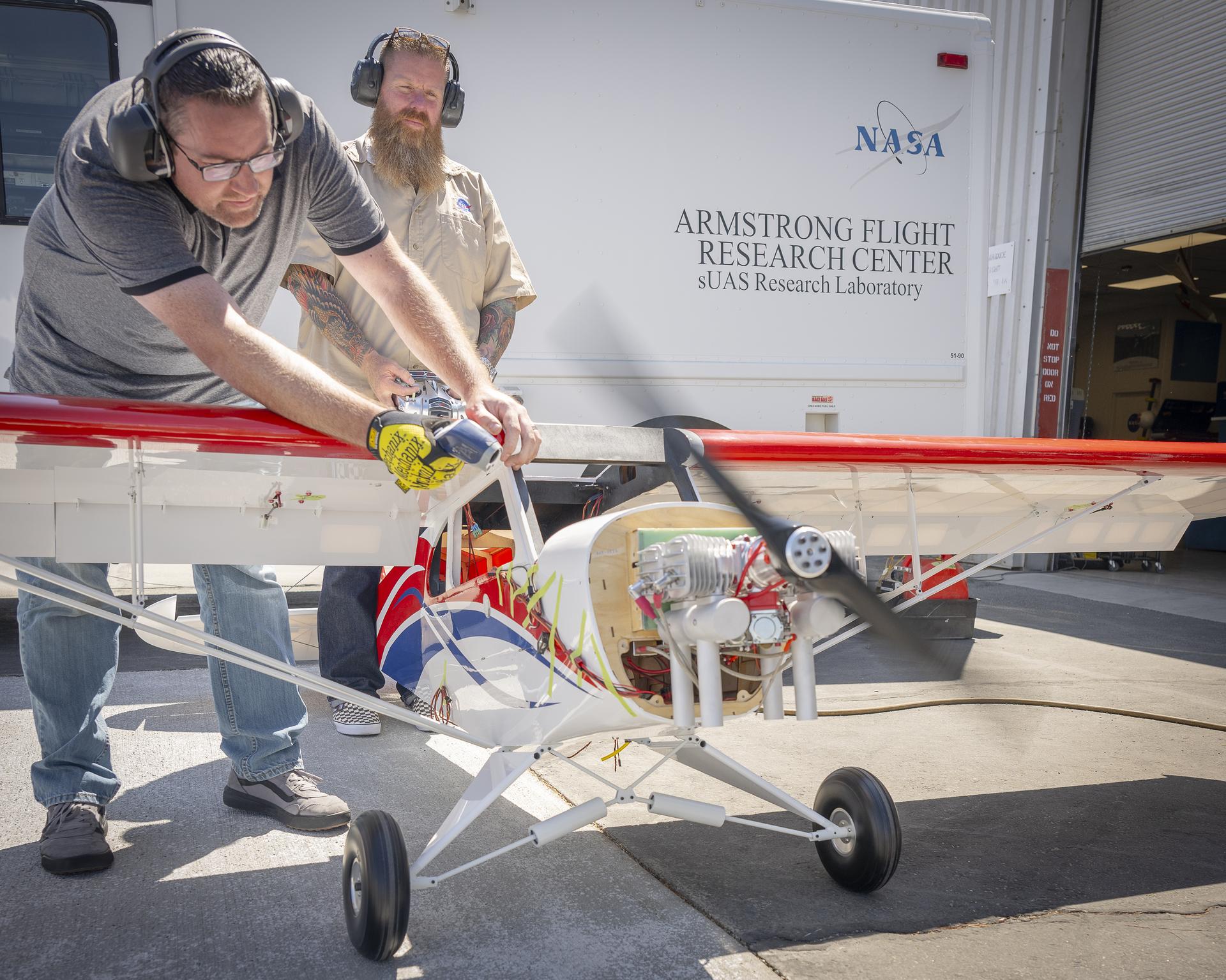
One man manages engine speed with a hand-held controller, while another firmly holds the subscale aircraft in place.
Justin Link, left, holds the subscale aircraft in place, while Justin Hall manages engine speed during preliminary engine tests on Friday, Sept. 12, 2025, at NASA’s Armstong Flight Research Center in Edwards, California. Link is a pilot for small uncrewed aircraft systems at the center’s Dale Reed Subscale Flight Research Laboratory and Hall is the chief pilot.
NASA/Christopher LC Clark

Flight expertise

Each staff member serves as an experienced and certified subscale aircraft pilot and is prepared to fly unique one-of-a-kind or modified commercial aircraft wherever the mission requires.

NASA’s FireSense project conducted flights in the Geneva State Forest, located about 100 miles south of Montgomery, Alabama. NASA Armstrong flight research staff integrated the instrument onto an Alta-X drone and tested the system before deployment. Two team members then transported the drone and sensor to the forest, prepared the vehicle for flight, and operated it during the mission. The NASA sensor was flown on the drone to demonstrate how remotely piloted aircraft can gather localized weather data that influences smoke movement and fire behavior. This information may help operational agencies improve wildfire decision-making and better allocate firefighters and resources.

Other missions occur closer to NASA Armstrong, such as the Enhancing Parachutes by Instrumenting the Canopy (EPIC) project. EPIC involved air‑launching a capsule containing a parachute and flexible sensor from the Alta‑X. Laboratory staff piloted the flights, supported flight operations, and worked with the EPIC team to design and integrate the parachute‑drop mechanism and safety system into the aircraft.

These tests demonstrated that a flexible sensor could help researchers study supersonic parachutes. Continuation of this work can help fill gaps in computer models, making supersonic parachutes safer and more reliable for delivering science instruments and payloads to Mars.

Two men integrate instruments onto a drone.
Justin Link, left, pilot for small uncrewed aircraft systems, and Justin Hall, chief pilot for small uncrewed aircraft systems, install weather instruments on NASA’s Alta X drone at the agency’s Armstrong Flight Research Center in Edwards, California. Members of the center’s Dale Reed Subscale Flight Research Laboratory used the Alta X to support the agency’s FireSense project in March 2025 for a prescribed burn in Geneva State Forest, which is about 100 miles south of Montgomery, Alabama.
NASA/Steve Freeman

Advancing challenging research

The Dale Reed Subscale Flight Research Laboratory uses rapid design and testing capabilities to help small aircraft fly big ideas. These concepts could lead to future breakthroughs that support NASA’s missions across aeronautics, science, and exploration.

For decades, NASA and its partners have advanced Automatic Collision Avoidance Technology. The research demonstrated an autopilot could detect and recover from an imminent ground collision – a capability now helping save lives in high‑performance U.S. military jets. NASA Armstrong had key roles in that work and developed a simplified version, the Automatic Ground Collision Avoidance System, which was installed on the DROID for testing.

The system demonstrated on the DROID — developed to assist general aviation pilots as well as remotely piloted and autonomous aircraft — performed well and led to further research toward a version that provides alerts and steering cues. The NASA Armstrong Technology Transfer Office is working to license the technology for U.S. businesses to develop the system as a commercial product.

The Prandtl‑D (Preliminary Research Aerodynamic Design to Lower Drag) flying‑wing glider was also designed, fabricated, and flown at NASA Armstrong. Researchers found that its twisted wing design could reduce drag and generate thrust at the wingtips, advancing concepts that may support greater fuel economy for future aircraft. The original Prandtl‑D is now part of the Smithsonian National Air and Space Museum collection in Washington, and the Prandtl-D3 is at the California Science Center in Los Angeles. Researchers continue developing the next generation of the design in the laboratory.

A wide range of capabilities in the laboratory help transform promising concepts into flight-ready test structures. These include rapid prototyping using traditional and advanced 3D manufacturing techniques, as well as composite and conventional fabrication processes. The team of engineers and technicians also provides custom component design and specialized fabrication to meet unique research needs.

The laboratory supports electrical and mechanical design, hardware and software integration, and the safety and flight-readiness processes required for successful missions. Additional technical facilities, such as the Experimental Fabrication Branch and the Environmental Laboratory at NASA Armstrong, further enhance these capabilities. Together, they support development, testing, and validation activities that advance NASA’s aeronautics and exploration goals.

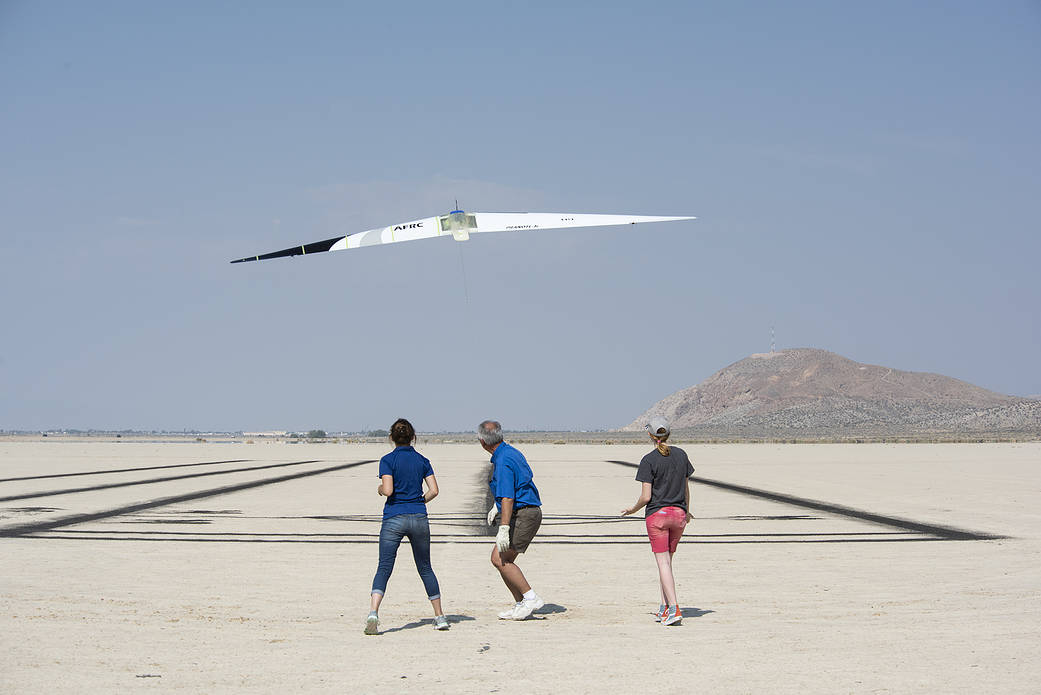
Deborah Jackson, Al Bowers and Abbigail Waddell successfully launch the subscale Prandtl-D 3C glider.
NASA

Details

Last Updated

Jul 15, 2026

Editor
Dede Dinius
Contact

Source: www.nasa.gov

Posted on Leave a comment

NASA Pushes New Wing Design to Find Structural Limits

3 Min Read

NASA Pushes New Wing Design to Find Structural Limits

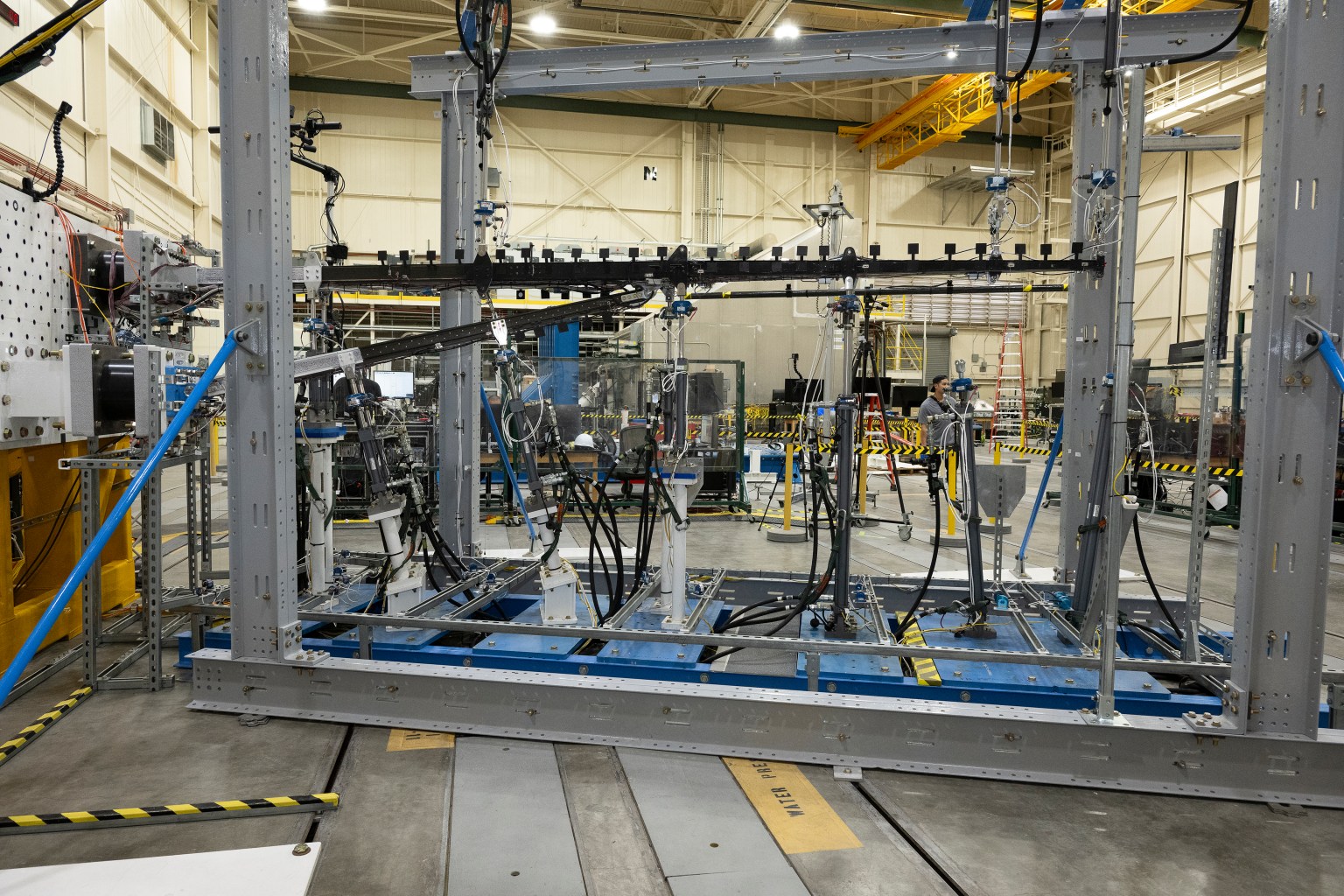
A wide view of a test structure in a laboratory shows a full test assembly secured inside a steel rig. Hydraulic lines, sensors, and support equipment surround the structure, with additional lab equipment visible in the background.

The 15-foot Structural Wing Experiment Evaluating Truss-bracing test article is fully installed in the Flight Loads Laboratory at NASA’s Armstrong Flight Research Center in Edwards, California, on Wednesday, May 20, 2026. The model is part of NASA’s research to develop technologies for future ultra-efficient aircraft.

Credits:
NASA/Carla Escamilla

NASA researchers recently put a new wing design, appearing long and thin with a lightweight structural design, through a series of grueling tests to find its structural limits. What they found left them encouraged about the wing’s potential, even when they pushed it past its intended limits.

The 15-foot Structural Wing Experiment Evaluating Truss-bracing (SWEET-15) test article is part of NASA’s research to develop future ultra-efficient aircraft. The design incorporates a long wing supported by an aerodynamic strut, based on NASA’s earlier Transonic Truss‑Braced Wing concept.

The research team is working to understand whether SWEET-15’s design and its new lightweight structural designs could help commercial airliners save fuel. But first, they need to understand how it behaves under the kinds of force wings experience in flight.

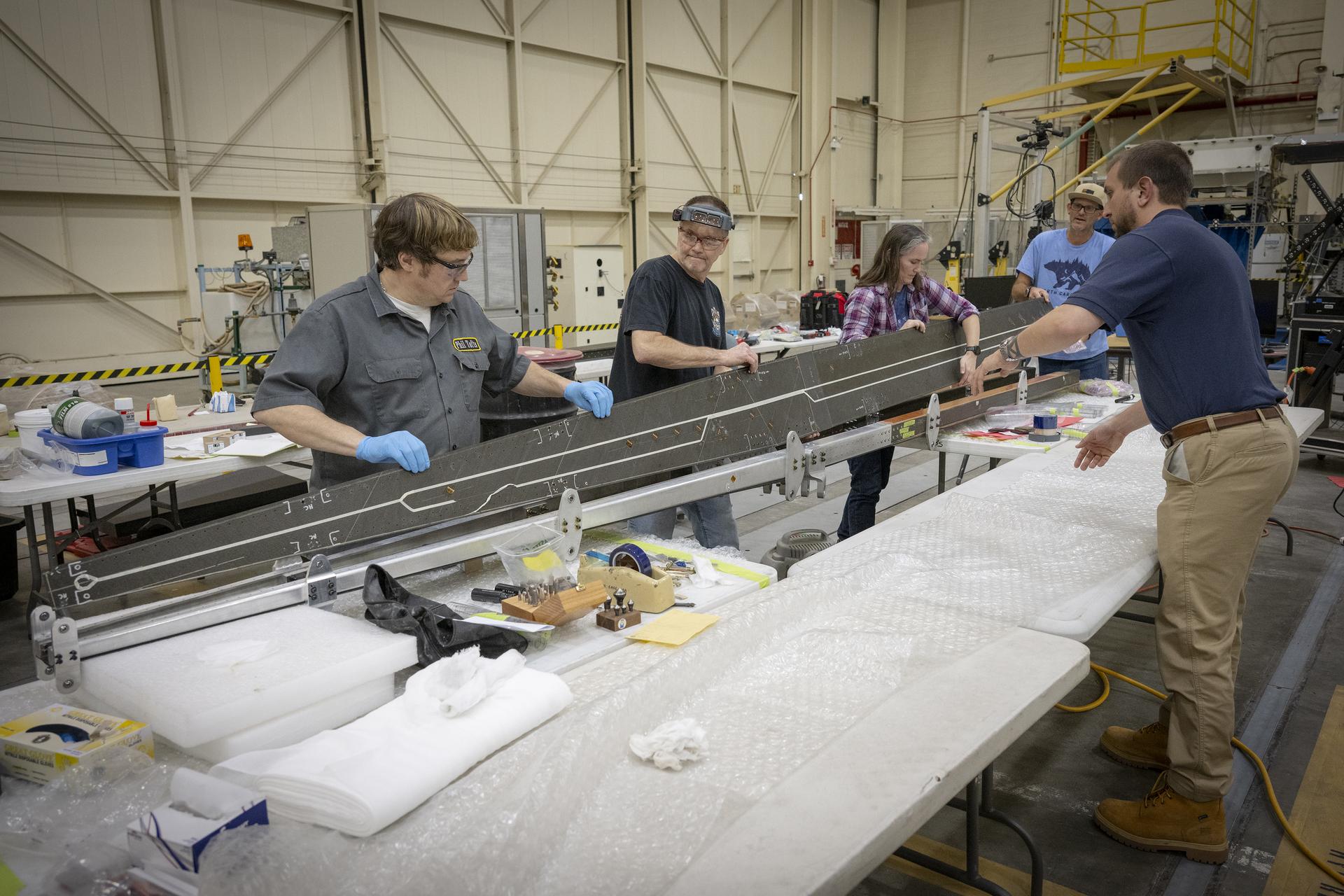
A group of people work together in a large workshop, handling and inspecting a long metallic structure laid across padded tables. Tools, materials, and protective equipment are spread across the workspace.
Lab technicians Phil Tofts, Chris McLain, and Jeff Howell and NASA engineers Erin Anderson and Richard Larson prepare the 15-foot Structural Wing Experiment Evaluating Truss-bracing model in the Flight Loads Laboratory at NASA’s Armstrong Flight Research Center in Edwards, California, on Thursday, Dec. 11, 2025. The model is part of NASA’s research to develop technologies for future ultra-efficient aircraft. 
NASA/Christopher LC Clark

The SWEET-15 design originated with combining five different advanced composite manufacturing and assembly technologies that enabled the novel structural design. The 15-foot-long test article was then designed and fabricated at NASA’s Langley Research Center in Hampton, Virginia, before traveling to NASA’s Armstrong Flight Research Center in Edwards, California, for testing.

Over several months, NASA engineers intentionally bent the test wing in the Flight Loads Laboratory at NASA Armstrong. Numerous strain and load sensors, including fiber-optic strain sensors, were placed throughout the structure to track how the wing responded as forces increased.

The data from the sensors confirmed the predictions made by NASA’s computer models. According to initial findings, the wing withstood the anticipated in-flight forces without issue. The results provided the team with confidence in the new manufacturing approaches and methods for connecting wing parts used in SWEET-15, which could support future efficient aircraft designs. The manufacturing approach, developed at NASA Langley used the Integrated Structural Assembly of Advanced Composites robot, aims to produce lighter and stronger composite structures for aerospace vehicles.

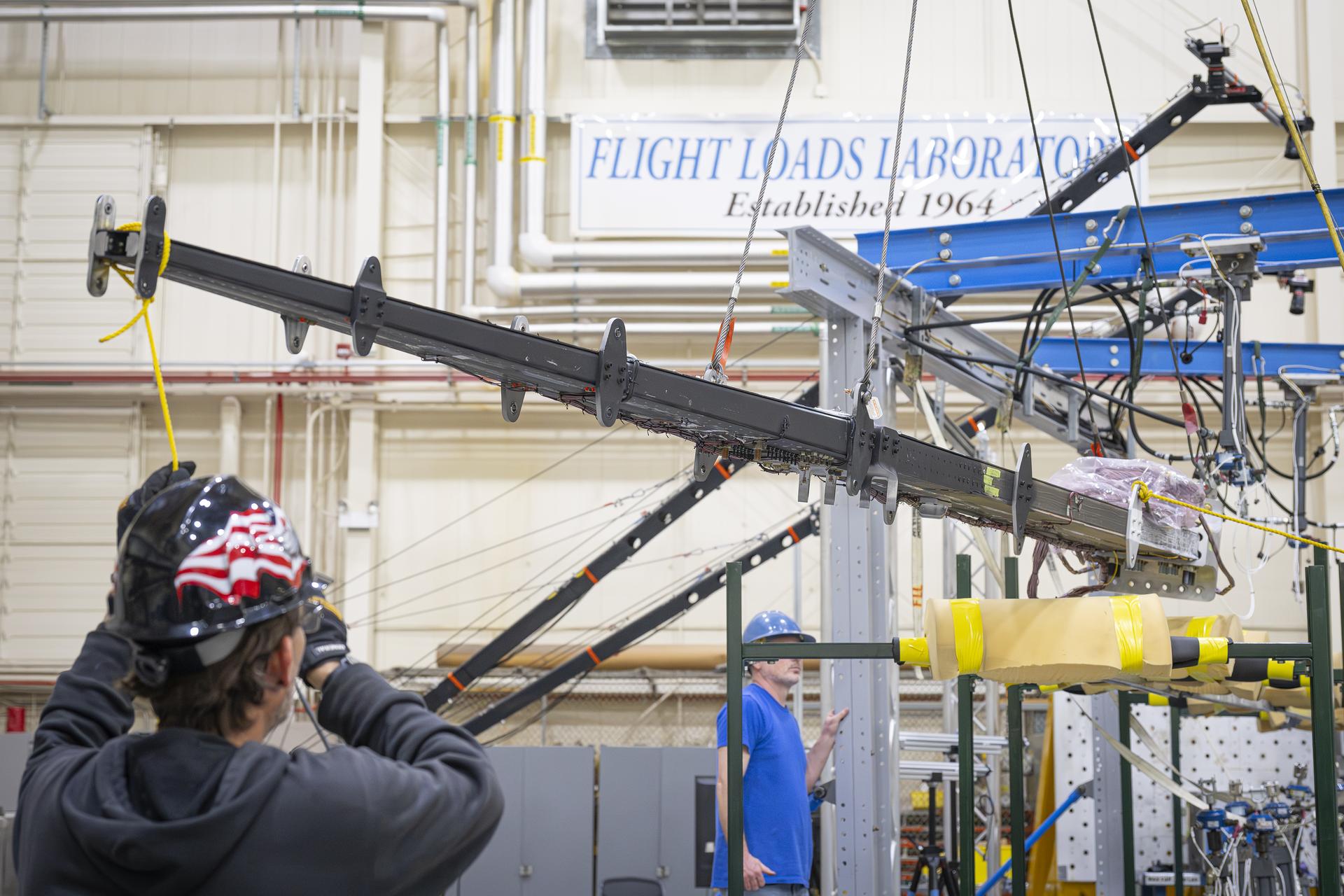
A long beam is suspended in a laboratory while personnel observe and guide its placement. Overhead support equipment, cables, and lab infrastructure surround the test area.
Lab technicians Jeff Howell, left and Chris Mount install the 15-foot Structural Wing Experiment Evaluating Truss-bracing model in the Flight Loads Lab at NASA’s Armstrong Flight Research Center in Edwards, California, Wednesday, February 11, 2026. The model is part of NASA’s research to develop technologies for future ultra-efficient aircraft.
NASA/Christopher LC Clark

The test concluded with a deliberate test-to-failure, where engineers increased loads beyond the wing’s design limits to determine how and where it would fail. The structure ultimately failed at roughly 127% of its design limit load, with visible damage appearing near the back edge of the wing and in the upper wing cover. This element of testing provided valuable insight into how the joints connecting the wing to its main strut and a secondary one, called a jury strut, behave under forces beyond the expected flight envelope.
This marks the first time a representative composite truss-braced wing configuration has undergone this type of structural evaluation.  It was made possible only through NASA collaboration across centers and projects, with researchers utilizing agency resources such as the Fiber Optic Sensing System developed to gather data on both aircraft and spacecraft.

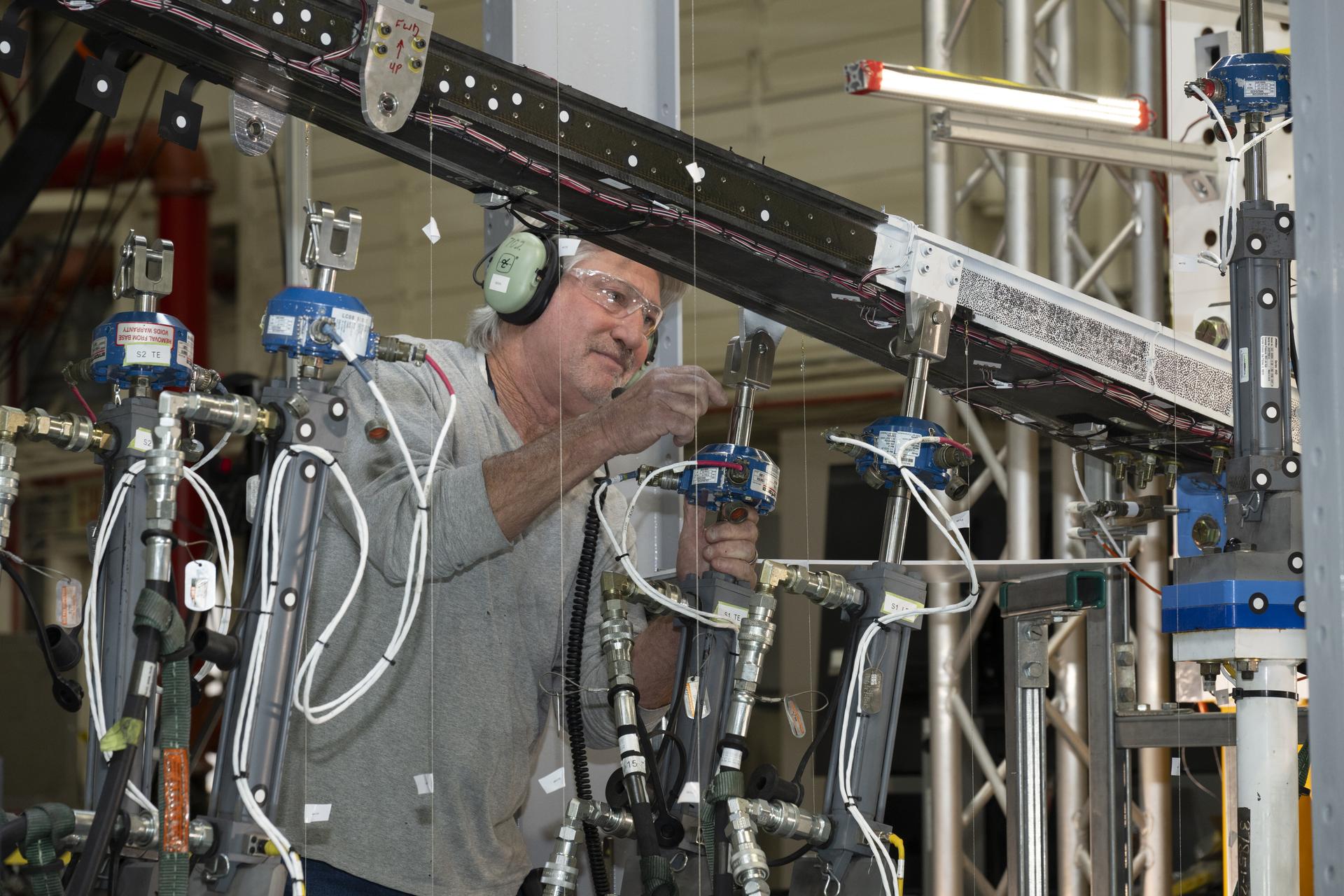
A man wearing ear protection works closely with multiple hydraulic and instrumentation units connected to a large beam mounted on a test structure. Numerous cables, hoses, and measurement devices extend from the setup.
NASA research engineer Walter Hargis regulates the 15-foot Structural Wing Experiment Evaluating Truss-bracing model in the Flight Loads Laboratory at NASA’s Armstrong Flight Research Center in Edwards, California, on Tuesday, March 31, 2026. The model is part of NASA’s research to develop technologies for future ultra-efficient aircraft. 
NASA/Ryan Kline

To prepare for the testing, engineers at NASA Langley designed, analyzed, and manufactured the wing and completed safety preparations and lab setup.

Researchers will now analyze the data collected during testing to inform future airframe designs and support NASA’s ongoing efforts to develop more efficient aviation technologies.

The work is being conducted through NASA’s Subsonic Flight Demonstrator project in the agency’s Research Technology Mission Directorate. The successful testing of multiple innovative components marks a milestone in NASA’s aeronautics research.

To learn more, visit:

https://www.nasa.gov/aeronautics/

Source: www.nasa.gov